

Marketing for IT services companies: how to win projects in the US
An IT services firm sells its team and its track record, because it cannot demo a finished product. Marketing therefore runs on proof: case studies, reviews, directory profiles, engineering articles, trust pages and partner referrals, with ads that lead people to that proof. We cover how enterprises, mid-market companies, small businesses and agencies choose a vendor, and which channels work for each.

How does marketing IT services differ from marketing software?
A client who commissions custom development, a cloud migration or a managed support contract is buying something that does not exist yet: a system built around their needs, or a service delivered for years. They cannot try the result in advance, so they price the risk instead. Can this team handle it? Will they hit the date and the budget? Will the key people still be on the project in month six?
That is the core difference. A software company can offer a free trial and a product tour. A services firm has to persuade through evidence: similar projects, named people, a clear process and the word of clients who already worked with you. The channels look familiar (search, content, events, LinkedIn), but almost every touchpoint has to answer one question: "Have you done this before, for a company like ours?"
This article is about firms that build, integrate and run custom systems: software development shops, systems integrators, cloud consultancies and managed service providers. If you sell your own SaaS product, the playbook is different (free trials, onboarding, churn). If you are a solo freelancer, your path runs through a portfolio and referrals more than through the channels below. For the general mechanics of a corporate buyer, see our article on marketing at a large company.
How do US buyers choose a development or IT services partner?
Before you pick channels, look at how your buyer actually decides. In its 2026 buyer research, Forrester reports that a typical business purchase involves 13 internal stakeholders and nine external influencers, and that goes up for complex or strategic deals. Procurement is a decision-maker in 53% of buying cycles and joins from the start.
B2B buyers are under immense pressure to justify investments and minimize risk.
Barbara Winters, VP and principal analyst at Forrester, in the 2026 State of Business Buying press release
Those numbers are for business buying in general, not only IT services, but they match what sales teams in this niche see. Your buyer is rarely one person, and the person who finds you is often not the one who signs. We group the buyers we meet most often into four types.
The enterprise with a formal process runs an RFP or a vendor assessment: written requirements, legal and security review, a shortlist and a scoring sheet. The first names on that shortlist usually come from colleagues or from a firm already in the building. The key factor is proven experience with a similar project: same industry, same scale, same constraints, measured results.
The mid-market or fast-moving company can pick a vendor on trust and speed. A VP or CTO asks peers, checks a few directories, reads two case studies and has a call. This is where a younger firm can get its first large logo, because nobody is forcing a three-bid process.
The small business without a technical team asks friends and local contacts, and if that fails, it searches Google. It cannot judge your stack or methodology, so it judges the website, the writing, the reviews and how you answer an email. Once it finds a firm it likes, the search usually stops.
The agency or prime contractor looking for a subcontractor checks its bench of trusted teams first, then asks in its network and in industry Slack or Discord communities. It uses directories when it needs to compare two or three similar candidates or find a skill it lacks.
| Buyer | How they search | What they check | Channels that reach them |
|---|---|---|---|
| Enterprise with a formal RFP process | Peer recommendations, then a formal RFP or vendor assessment | Similar projects with measured results, security and compliance evidence, financial stability, insurance | Case studies with metrics, ABM, procurement registrations, cloud marketplaces, industry events |
| Mid-market or fast-moving company | Peers, directories such as Clutch, a quick shortlist | Relevant experience, the actual team, speed and initiative in the first calls | Case studies, expert articles, directory profiles, LinkedIn, in-person meetings |
| Small business | Personal contacts, then Google | Website, portfolio, reviews, how fast and clearly you reply | SEO, Google Ads, service pages, Google Business Profile |
| Agency or prime contractor needing a subcontractor | Own bench, network, industry communities, directories for comparison | Skills, availability, rates, reliability | Networking, partner programs, directories, a small paid trial project |
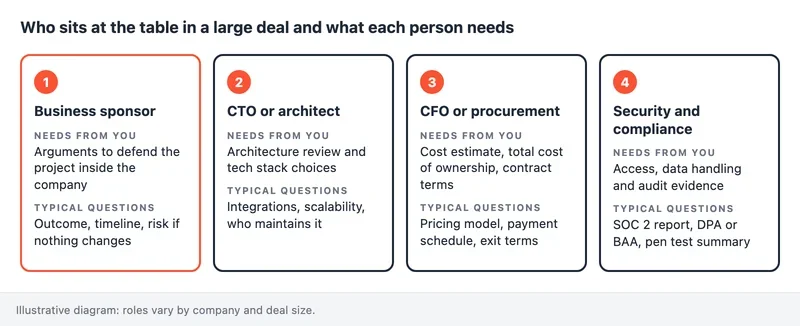
In a large deal a group decides. A business sponsor frames the problem, the CTO or architect reviews the solution and the stack, the CFO or procurement team looks at total cost and contract terms, and security and compliance set the rules for access and data. Each person needs different material: the sponsor needs arguments to defend the project internally, the architect needs a technical breakdown, finance needs an estimate with a timeline, and security needs evidence. Often they all meet you for the first time in one meeting, and four sets of questions arrive at once. The diagram shows the four roles and what each needs.
Positioning: why people will recommend you
Referrals work when someone can describe you in one sentence: "They integrate NetSuite with Shopify" or "They build mobile apps for community banks." Nobody can pass along "we build anything on any stack." Specialization also tells a buyer what to hire you for.
Specialize along one of three axes: technology (Salesforce, AWS, .NET, React Native), industry (healthcare, logistics, financial services) or type of task (cloud migration, legacy modernization, integrations, security remediation). You can keep a wide service list, but lead with the area where you have the most case studies and the easiest proof.
Each service needs its own page, so a visitor who arrives from a search or an ad sees the answer to their problem at once. A standard page has these blocks:
- what the service is, which problem it solves and who it is for;
- case studies for this service, with industry and metrics;
- the team: who works on the project, in which roles, with what experience;
- how the work runs: phases, timeline and contract type (fixed price, time and materials, retainer);
- price ranges or the factors that drive price;
- answers to common questions and links to expert articles;
- a contact form that asks for a project description, timeline and budget range.
Before you redesign, study three to five competitors: how their service and case study pages look, how the menu is built, which search terms bring them traffic and how they lead a visitor to a request. Traffic analytics tools show where a competitor's visits come from. The diagram below is an illustrative report: about 45% of visits from search, roughly a third direct, a fifth from other sites, and almost nothing from social and email.
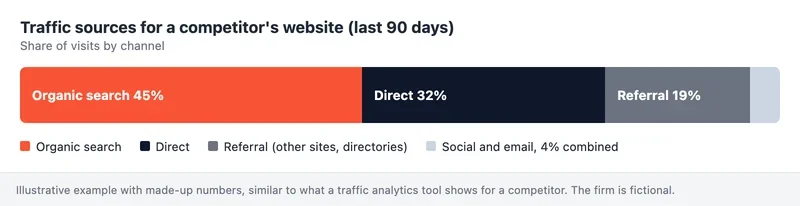
That pattern is common for IT services: buyers either search for a solution or already know the firm from a recommendation and type its name. So invest in two things: pages that rank for the problems people search, and brand recognition that drives direct visits.
Case studies and testimonials: a services firm's main asset
For a large buyer, what a vendor says about itself carries little weight. They want to know whether you can solve their problem, and they look for confirmation in similar projects. In IT services a case study is the document the company is judged on.
A strong case study follows one structure, and each part answers a question from someone in the buying group:
- Task and context: industry, company size, what was not working before the project.
- Constraints: deadline, budget, legacy systems, security and compliance requirements.
- Team and approach: how many people, which roles, how you worked with the client.
- Solution: architecture, stack, integrations and why you chose them.
- Challenges: what did not go to plan and how you handled it.
- Results in numbers: processing time, load, share of automated steps, cost or revenue impact.
Many projects sit under an NDA, but that is not a reason to stay silent. An anonymized case, such as "a regional pharmacy chain, integrating its inventory system with online marketplaces," keeps the essentials: industry, scale and results. Agree with the client what you may disclose when you sign, and put it in the contract, so you are not begging for a case study after delivery.
Here is a hypothetical example of the format, clearly labeled as such. A mid-size distributor with 400 employees runs orders on a 15-year-old ERP. Constraint: no downtime during the quarter-end close. Team: six people for five months. Solution: an integration layer between the ERP and the new warehouse system, then phased cutover by site. Challenge: duplicate customer records found in week three, fixed with a one-time cleanup. Result: order entry time down from 11 minutes to 4 and no missed shipping days during cutover. The numbers are invented for illustration, yours must come from the project.
Client testimonials work the same way. A line like "great and professional work" on a letterhead tells a large buyer nothing. A useful testimonial rates specific things: were the targets met, were the deadlines kept, how was communication, did the team understand the task. Ask the client to say so in those terms.
A video testimonial, where a client names the company and their title and describes the project in a minute or two, is harder to fake and works well beside a case study on a service page.
Clutch, G2 and Gartner Peer Insights: do IT services firms need them?
Directories and review sites have become a research channel, especially for buyers who purchase a service for the first time and do not know whom to ask. The ones we see most in this niche are Clutch and GoodFirms for services firms, G2 and Gartner Peer Insights for software products and platforms, and the vendor directories run by cloud providers. A services firm usually belongs on Clutch and GoodFirms, plus G2 or Gartner Peer Insights only if it also sells a product.
Review sites differ in how much they check. Clutch says it verifies a reviewer's identity using the login (LinkedIn, Google or a company email) and the work history submitted, and it marks a review as Verified or Not Verified. Clutch profiles also show an average hourly rate and a minimum project size. According to Clutch's help center, companies that leave those optional fields empty are excluded from filtered results on directory pages, and buyers use those filters often. So fill them in honestly.
Prepare for every directory while the project is still running:
- pick projects from the last two years where your team covered the whole cycle, from discovery to launch;
- get the client's consent to be named, and a contact who agrees to be reached for verification;
- write down the results and the stack while the team still remembers the details;
- keep your hourly rate range, headcount and focus areas current.
Two cautions. First, a directory position rarely decides a deal by itself. It shapes perception: the firm looks open, active and invested in its reputation. Some buyers, agencies in particular, distrust the top of any paid ranking and assume the leaders cost more. The practical goal is to show up in the right categories, industries and cities, not to chase first place.
Second, never buy or fabricate reviews. The FTC's final rule on reviews and testimonials bans fake reviews, paying for positive or negative sentiment, undisclosed reviews by insiders, and threats used to suppress negative reviews, and it lets the agency seek civil penalties against knowing violators. The rule is written about consumer reviews, so ask your counsel how it applies to your B2B situation, but the safe habit is the same: ask real clients for honest reviews and offer nothing in exchange for a rating.
Thought leadership: LinkedIn, engineering blogs and conferences
The technical person on a buying team does not trust advertising. What convinces them is analysis that shows you understand their problem. So an IT firm's expert content should be articles about solved problems, migrations and architecture choices, post-mortems, and talks where the audience can question the author afterward.
Home base for that content is your own engineering blog on your own domain, because it is the page that ranks and the page you can link to from a proposal. Distribute it where engineers and executives already read: LinkedIn for decision-makers and the broader network, plus Hacker News, dev.to, Medium or relevant subreddits when a post is truly technical. Advertising copy falls flat there. What works is a deep look at one problem with numbers and code, an honest account of a failure, or a comparison of technologies under real load. Let engineers write with an editor's help, and let the author answer comments personally. A corporate engineering blog also helps hiring: candidates read the same articles.
Other formats that show expertise are built around the blog:
- a LinkedIn presence for your CTO or lead architect with short observations, breakdowns and article announcements;
- talks at industry conferences, user groups and meetups, after which attendees come to the speaker with real problems;
- webinars and open technical reviews for clients in one industry;
- a podcast or video series that interviews clients and engineers;
- guest articles in trade media read by your future clients' executives.
Before placing a guest article, check that the outlet has its own organic audience. Traffic analytics tools show a site's organic traffic over time, and you can compare outlets with them. For paid reach, LinkedIn Ads and sponsorships of newsletters and podcasts in your niche are the common options, usually booked directly with the publisher.
Search: Google Ads and SEO built around the buyer's problem
Search captures people who already know their task: "NetSuite implementation for manufacturers," "custom mobile app development company," "AWS migration partner," "managed IT services for law firms." For a services firm that is high-intent demand, but the volume is small and every firm in the niche bids on it. A useful segment is migration and replacement: queries like "migrate off legacy ERP" or "Jira alternative for regulated teams" come from companies with a specific task, a deadline and usually a budget.
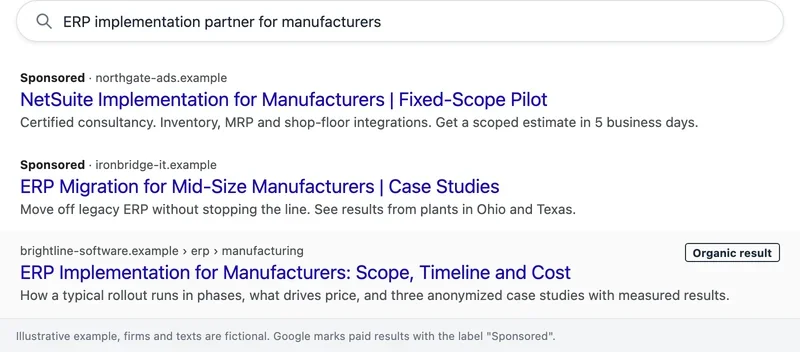
Here is an illustrative results page for "ERP implementation partner for manufacturers": two ads at the top, each labeled "Sponsored," then the organic results below.
In Google Ads for IT services, three things matter most:
- separate ad groups for each service and stack, so the ad and the landing page match the query;
- negative keywords to filter out job seekers, students and freebie hunters, such as "jobs," "salary," "course," "tutorial," "free," "download." Google's negative keywords guide explains the match types, and notes that for negative keywords you need to add synonyms and plural forms yourself;
- remarketing to people who read case studies and service pages but did not submit a request. The sales cycle is long, and staying visible helps you wait for the buying moment.
SEO brings leads more slowly but more cheaply if you write pages and articles around the client's problems: "how to migrate data from a legacy CRM," "how much does managed IT support cost," "why is my Shopify store slow." These queries have lower volume, but the people asking have a specific pain, and a deep article proves your expertise at once.
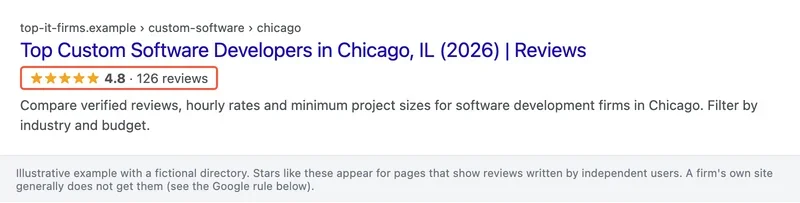
One US-specific detail on stars in search results. Star ratings next to a result build trust before the click, but Google's review snippet documentation says pages using LocalBusiness or other Organization markup are ineligible for the star feature when the reviewed entity controls the reviews about itself. In practice your own site's testimonials will not earn stars. The stars you see for IT firms usually belong to a directory page that shows independent reviews, like the illustrative result below.
Local visibility for managed IT and support
If you deliver on-site services (managed support, administration, equipment maintenance), clients look for you nearby, and the map decides. The image below is an illustrative Google Maps list for "managed IT services near Austin, TX": companies with ratings, review counts, hours and addresses. Buyers compare these listings and call the ones with recent reviews and complete details.
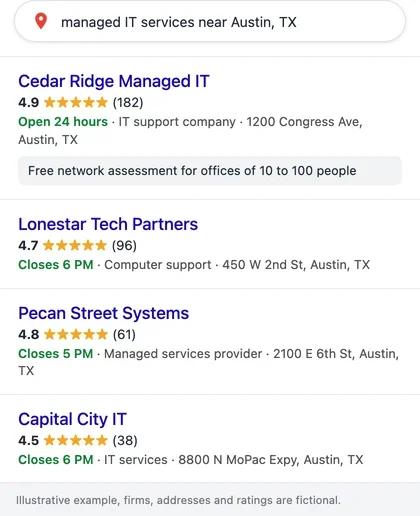
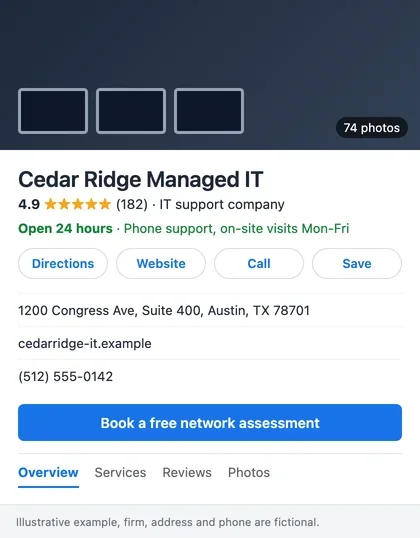
Google's local ranking guide names three factors: relevance, distance and prominence, where prominence draws on links, review count and ratings. It also says businesses with complete and accurate information are more likely to show up in local results. Fill in your Business Profile completely: categories (IT support company, managed service provider), service area, hours, phone number, photos of the office and team, and a link to the service page. A clear first-step offer works well, for example a free network assessment, after which a maintenance contract with stated response times is an easier conversation. Our article on SEO for local businesses covers the rest of the local setup.
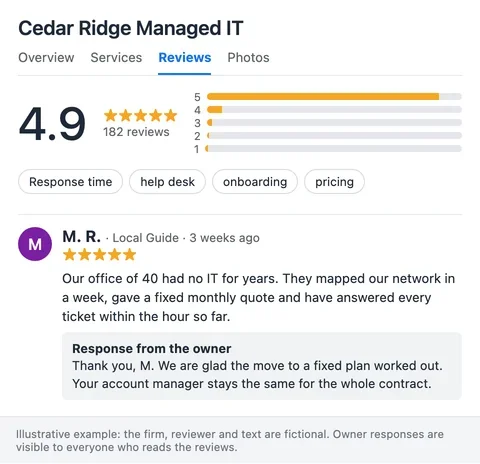
Reviews matter more for support contracts than for custom development: the client is choosing a vendor for years and wants to know how quickly you respond. Ask for a review after you resolve a hard ticket, when the client is happy, and reply to every review, including negative ones. Google says responding to reviews shows you value feedback, and that positive reviews and helpful replies can help your business stand out. The next image shows an illustrative reviews tab: a 4.9 average from 182 reviews, topic chips, and the first review with an owner response.
Partnerships: cloud providers, other agencies and customer referrals
For many integrators a large share of projects comes through partners. The first channel is vendor and cloud partner programs. The AWS Partner Network describes itself as a global community of organizations that build solutions and services on AWS, and lists co-selling with AWS sales teams and selling through AWS Marketplace among the benefits. Microsoft runs a similar motion: on its services co-sell page, Microsoft says partners who attain designations, specializations or Azure Expert MSP status can co-sell with Microsoft sellers, and encourages them to publish a business profile that Microsoft sellers see when they look for a partner. From a marketing view that profile is a storefront inside the vendor's own sales organization.
Cloud marketplaces are a second reason to join. AWS Marketplace says that software vendors, data providers and consulting partners can sell software, services and data there, and that AWS handles metering, billing and collections. That can matter in enterprise deals, because a buyer with a cloud spending commitment may prefer to buy through the marketplace. Requirements differ by program: for example, Google Cloud's Marketplace requirements say your organization must join and stay in good standing in the Google Cloud Partner Network, hold a Marketplace vendor account and payment profile, and, for software, host your product primarily on Google Cloud. Read the current terms before you invest.
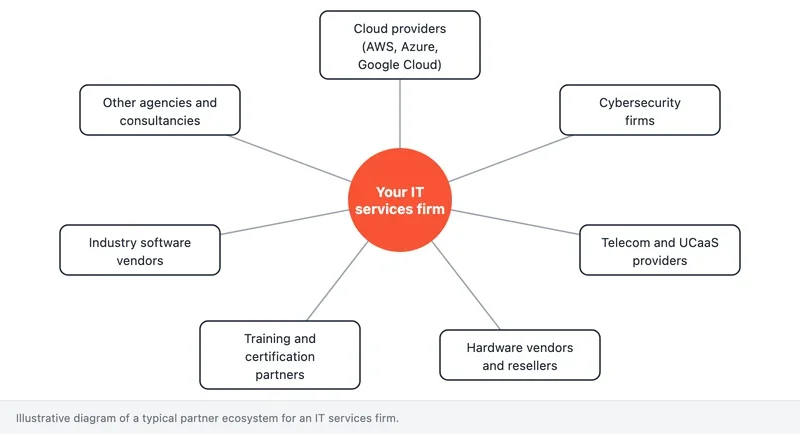
Your own market neighbors can become partners too: companies that sell related services to the same buyers. The diagram below shows a typical ecosystem: cloud providers, telecom and UCaaS providers, training partners, cybersecurity firms, hardware vendors, industry software vendors and other agencies. With each you can agree on mutual referrals or a joint offer, for example a CRM integrator and a telephony provider solving one client's problem together.
If you run your own referral or reseller program, describe it on a page of your own: who gets paid and for what, how a referral is submitted, and how partners hear about the outcome.
The second channel is subcontracting for agencies and larger integrators. To get onto an agency's bench, describe your skills honestly, be willing to take a supporting role and have a couple of finished projects behind you, even a discounted one done to earn a reference. The reward is steady utilization and lower marketing cost. These projects often run under the agency's brand, so agree before work starts on whether you can publish an anonymized case study.
The third channel is referrals from your own clients. Make it a routine: ask after a successful phase, offer a credit on support for each client referred, and record in the CRM who referred whom. Partner traffic also shows up in your analytics as referral visits.
ABM and RFPs: working with large buyers
When one contract moves your annual revenue, mass advertising is less efficient than outreach to a list of named companies. That is account-based marketing (ABM). It comes in three common scales: one-to-one for a handful of key accounts with custom plays, one-to-few for a cluster of similar companies with semi-custom messaging, and one-to-many with automation across a long account list. It makes sense when each contract matters.
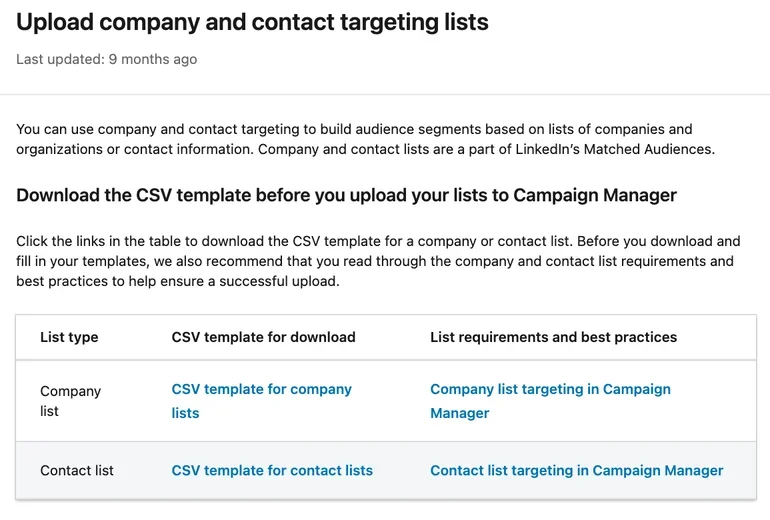
For an IT services firm, ABM looks like this: a list of 20 to 50 companies where your expertise is already proven by similar projects, a map of the decision-makers at each, and material written for their situation (a case study from the same industry, an estimate, an invitation to a private briefing). LinkedIn is the usual advertising side. Per LinkedIn's help page, company and contact lists are part of Matched Audiences and let you build segments from lists of companies or contacts, and the minimum audience size for an ad set is 300 member accounts, so a very short list will not run. Log every interaction in your CRM, or sales and marketing will not know where each account stands.
Large enterprises and public bodies buy through a formal process, usually an RFP. Marketing's job is to have everything procurement will ask for ready in advance: a portfolio of case studies, references and letters of recommendation, a description of your team and certifications, insurance certificates and financials. To bid on US federal contracts as a prime, SAM.gov says you need an entity registration, which assigns a Unique Entity ID, stays active for 365 days and must then be renewed. State and local governments and large companies run their own portals and rules, so check the specific terms with a lawyer. Set up alerts on the relevant portals for keywords such as "implementation," "modernization," "managed services" and the names of platforms you work with.
The same logic applies to your first big client: pitch a fast-moving company first, where decisions come quicker and without a procurement panel. That project then becomes the reference that gets you through a formal process later.
Trust pages, security evidence and compliance
Security is a separate gate for large and regulated buyers. Requirements for access, data storage and work inside the client's environment are checked before the contract is signed, often through a vendor security questionnaire. Have your answers ready and published where you can. A trust page that lists what you hold and how to request it saves a week of email in a typical deal.
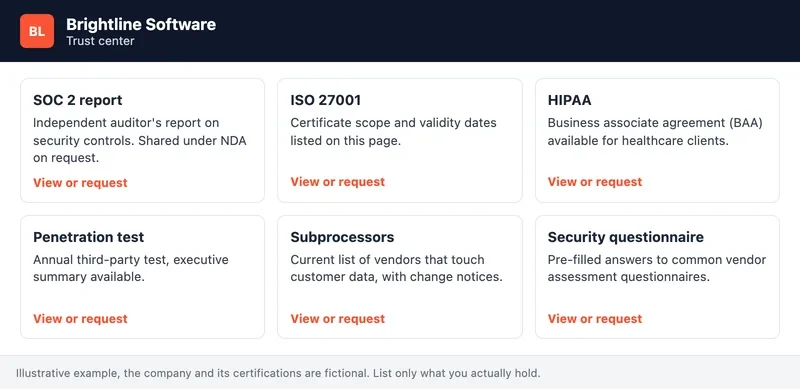
Buyers commonly ask for the following, depending on the industry:
- SOC 2. The AICPA describes SOC reports as assurance reports that help users assess the risks of outsourcing services, and SOC 2 examinations cover controls relevant to security, availability, processing integrity, confidentiality or privacy. Many enterprise questionnaires ask whether you have a current report;
- ISO 27001 certification, more common with international clients;
- HIPAA. Under the federal definition at 45 CFR 160.103, a business associate includes a person who creates, receives, maintains or transmits protected health information on behalf of a covered entity, and subcontractors that do the same. If you build or host systems that touch patient data, expect healthcare clients to ask for a business associate agreement;
- a penetration test summary, a list of subprocessors and a data processing agreement.
Do not claim a certification you do not hold. If a report is in progress, say so and give the expected date. If you are starting from nothing, pick the one framework your target buyers ask for most and plan the audit around it.
Compliance for your own marketing: email and privacy
Outbound is where IT services firms most often get into trouble. The FTC's CAN-SPAM guide says the law makes no exception for business-to-business email. Commercial emails must carry accurate header information and a non-deceptive subject line, identify the message as an ad, include a valid physical postal address and offer a clear opt-out, and you must honor opt-out requests within 10 business days. The guide lists penalties of up to $53,088 for each separate violating email.
Privacy law matters too. The California Attorney General's CCPA page says the law applies to for-profit businesses that do business in California and meet any one of three tests: more than $25 million in annual revenue, buying, selling or sharing the personal information of 100,000 or more California residents or households, or earning 50% or more of revenue from selling personal information. It also states that the exemption for business-to-business information expired on December 31, 2022. If you scrape or buy contact lists and run outreach into California, ask counsel whether your program is covered.
Cold email to purchased lists with no personalization also tends to produce few replies in IT services and damages your domain's sending reputation. Use consented or tightly targeted lists, personalize on a real reason for contact, and keep outreach volume low.
Nurturing a long deal: newsletters, video and webinars
Months pass between first contact and a signed development contract. In that time the client compares vendors, settles the budget and may forget who you are. Nurture the contact so your name is on the shortlist when the decision comes.
Match your materials to the stage of the deal:
- after the first meeting: a case study from the same industry and a short description of the team;
- after the proposal: a risk breakdown, the launch plan and what happens if dates slip;
- before the decision: contacts of clients who agreed to be references, and an invitation to talk with the future project manager.
A newsletter works when it gives value: a new case study, a technical breakdown, an invitation to a webinar or news about changes in the platforms your clients use. The same tool carries service emails to existing clients. Here is an illustrative example: a header with logo and tagline, a message from the account manager about renewing a support agreement.
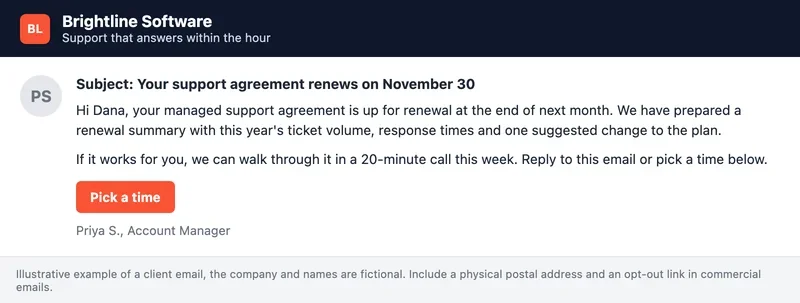
Video shows the people and the process: a technical lead's talk, an integration demo, an office tour and a client testimonial. Host the full video on YouTube or your own site and share clips on LinkedIn.
For existing clients, short messages cover support renewals, maintenance windows and upgrade offers, by email or through the support portal. Selling more support to a current client is usually cheaper than winning a new one.
Webinars and private case reviews for clients in one industry do three jobs at once: they show expertise, they add contacts to your database and they give you a reason to follow up. Reuse the recording in newsletters and on the service page.
What do projects cost, and how do you price in public?
Buyers want a range early. Clutch makes this explicit with its hourly rate and minimum project size fields. For context, a January to February 2026 survey by Techreviewer, a research and directory site, of 127 software development providers, 26.8% of them in the US, found 37.8% charging $30 to $49 per hour and only 6.3% charging $100 to $149 and 3.15% charging $150 to $199. That is a global sample, so treat it as a sign of how much offshore pricing pulls the average down, not as a US benchmark.
For US-based teams, here are illustrative ranges that we use for planning, not sourced data and not a quote: senior US engineers often bill from $100 to $250 per hour; a discovery or architecture phase can run $15,000 to $40,000; a first product or integration project can run $75,000 to $250,000; and managed support or retainers often sit between $3,000 and $15,000 per month. Your own numbers should come from your proposals.
On your site, publish the factors that move price (scope, integrations, compliance requirements, team seniority) and a starting range for each service. It filters out poor-fit leads and shows procurement you are not hiding anything.
How do you measure ROI, and where do you start?
In IT services a cheap lead means little: ten inquiries from students and one from a client with a budget look identical in a report. Track deals and revenue. Send website inquiries to the CRM, link deal stages to Google Analytics and your ad platforms, and add fields for the task, timeline and budget range to the form, so poor-fit requests are filtered before you pick up the phone.
Then calculate customer acquisition cost and customer lifetime value. With managed support the client pays for years, and in development the first project is usually followed by phases two and three. The ratio of the two tells you how much a lead is worth in each channel.
A first-quarter plan for a company starting marketing from scratch:
- Pick the primary customer type and one or two specializations with the most case studies.
- Rewrite service pages and write three to five case studies in the new format, including anonymized ones.
- Ask clients for testimonials that rate timelines, results and communication.
- Complete your profiles on Clutch and GoodFirms and, if you serve a local market, your Google Business Profile.
- Launch a Google Ads campaign for commercial queries with negative keywords and remarketing to case study readers.
- Publish the first engineering articles and start a LinkedIn presence for your technical lead.
- Join the partner program of the cloud or platform vendor you use most, and publish your profile.
- Connect the CRM to analytics and, after a quarter, compare channels by closed deals.
After a quarter it will be clear which channels start real conversations and which only bring traffic. Move budget to the first group and spend the freed-up resources on partnerships and ABM.
If you also sell to clients in Russia or the CIS, the playbook changes: search there runs mostly on Yandex and the review and rating platforms are local, so plan that market separately.
Frequently asked questions
What is IT marketing?
It is the promotion of companies that build, integrate and support software systems. For a services firm you are selling the team and its expertise, so the marketing rests on verifiable evidence: case studies, testimonials, expert articles, directory profiles and referrals. Advertising and SEO send people to that evidence. Cycles are long, and several people decide.
How can an IT company find clients?
The first projects usually come faster from your network: former clients of your employees, subcontracting for agencies and vendor partner programs. In parallel, write two or three case studies, build service pages and run Google Ads on specific commercial queries. Mass cold email to purchased lists without personalization rarely works in this niche, and CAN-SPAM applies to B2B email as well.
Do I need SOC 2 to sell IT services?
Not to start, but many enterprise and regulated buyers ask for a current SOC 2 report or an equivalent in their vendor questionnaire, and that can stall a deal. Ask your best-fit prospects what they require before you decide which audit to fund.
Are Clutch and G2 worth it?
Clutch and GoodFirms are worth a complete profile for most services firms, because buyers use them to compare. G2 and Gartner Peer Insights fit firms that also sell a software product. In every case, treat a directory as a place buyers verify you, not as your main lead source, and collect reviews honestly.
Should an IT company blog?
Yes, if you have engineers willing to write about real problems at least once a month. A blog builds trust with technical buyers, brings search traffic from professional queries and helps hiring. The return builds over months, so judge it by qualified inquiries and job applications over six months, not by views of the first post.
What is ABM in simple terms?
Account-based marketing targets specific companies instead of a broad audience. You pick a list of target clients, research each company and its decision-makers, and prepare personalized content and ads for them. It pays off with large contracts, where one deal can move the vendor's annual revenue.
Дата публикации:
Задать вопрос
Вопросы и ответы
Пока нет опубликованных вопросов. Задайте первый — после модерации он появится здесь.
Вам также может понравиться
Все статьи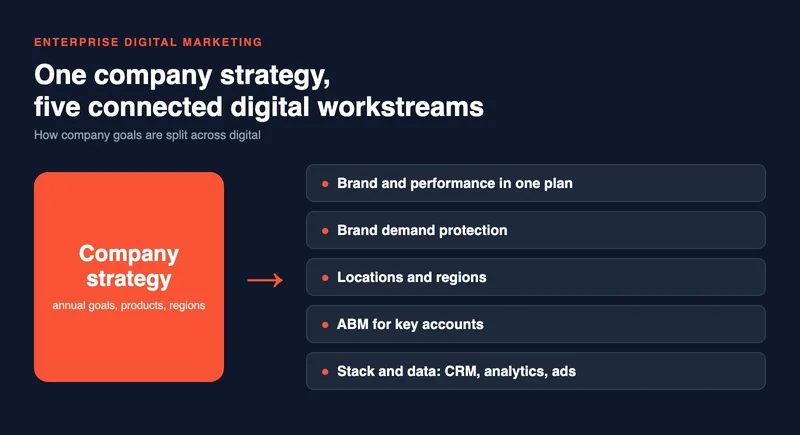
Enterprise
Enterprise digital marketing: how to build digital in a large company
Enterprise digital marketing: goals from strategy, one brand and performance budget, branded demand, ABM, CRM data, privacy, accessibility, team roles.
Local business
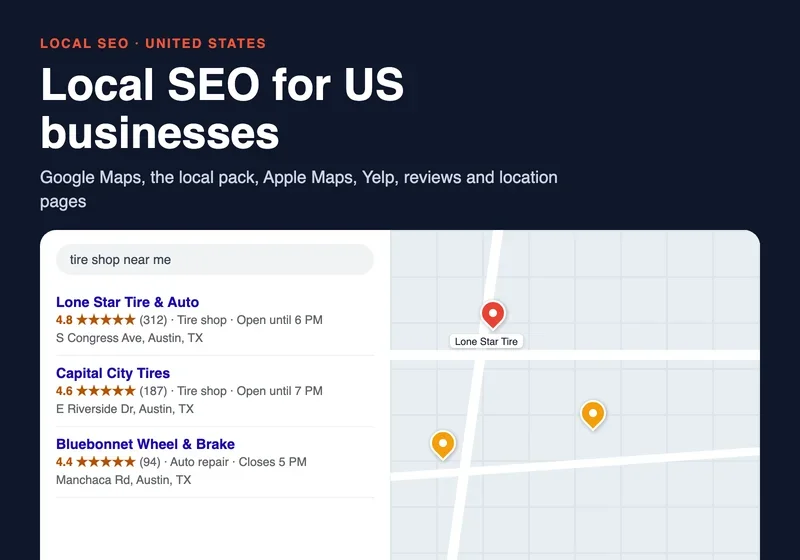
Local SEO: How to Get Your Local Business Into Google Maps and the Local Pack
US local SEO: Google Business Profile, local pack, Apple Maps, Bing, Yelp, NAP and citations, location pages, reviews rules and a three-month plan.

Fintech
SEO for Fintech Companies: Win Search Traffic and Customer Trust in the US
US fintech SEO: YMYL trust signals, not-a-bank and FDIC wording, product pages, app and web, PCI DSS, reviews, GA4 metrics and CFPB, FINRA and SEC ad rules.
Technical SEO
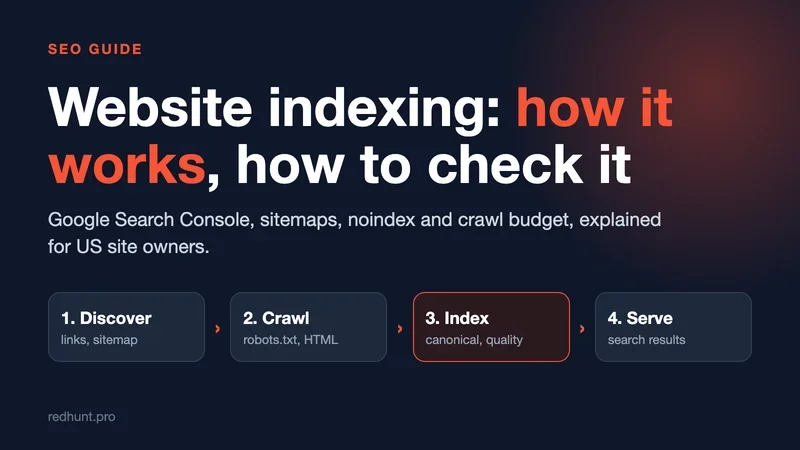
Website indexing: how it works, how to check it and how to speed it up
How Google indexes a site, how to check pages in Search Console, and how to speed it up with sitemaps, URL Inspection and IndexNow.