

Enterprise digital marketing: how to build digital in a large company
Large companies rarely lack channels. Money leaks at the seams between brand and performance, CRM and analytics, sales and agencies. We cover how to derive digital goals from company strategy, plan brand and performance as one budget, protect branded demand, connect data, handle privacy and accessibility, and split ownership between teams and vendors.

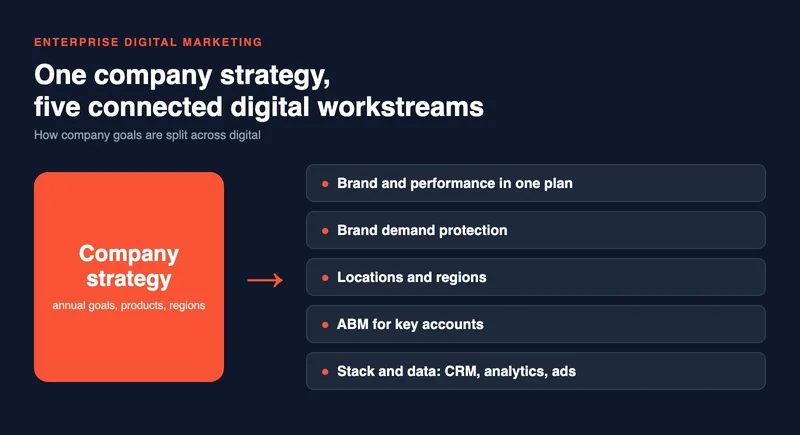
How enterprise digital marketing differs from a small business
In a small company, marketing often rests on one person: they pick a couple of channels, launch the ads and sort through the leads themselves. We described that starting point in our guide to local business SEO. In a large company the same channels run at a different scale: several products and brands, regions, separate sales teams, dozens of vendors, and budgets that the finance department signs off on.
The audience is wider too. A large company is read by customers, partners and resellers, investors, reporters and future employees. Each group needs its own channel and tone, but the company has one brand, and contradictions between messages get noticed fast.
The biggest difference is in the handoffs. One team buys display and video, another runs paid search, the CRM belongs to sales and the website belongs to IT. Each piece can work well on its own, and revenue still stalls because nobody owns the whole customer journey. Gartner's annual CMO Spend Survey shows the pressure this puts on leaders: in the 2025 edition, 59% of CMOs said their budget was not enough to carry out the year's strategy, and 39% planned to cut agency spend.
That defines the job of a digital lead at a large company: pull scattered activity into one system where every area has an owner, data flows from ads into the CRM and back, and brand and sales are planned together.
How do you derive digital goals from company strategy?
Marketing in a corporation serves the business strategy, not the other way around. In practice that means working top down: the company goal for the year, then the contribution expected from each product and region, then the digital task and the metric that will prove it. A simple test for any campaign: if its owner cannot name, in one sentence, the company goal it supports, rebuild or stop the campaign.
| Company goal | Digital task | Metric |
|---|---|---|
| Enter a new region | Build brand awareness and win the first leads | Branded searches in the region, cost per lead |
| Launch a new product | Explain the product and capture demand | Reach in the target audience, growth in product searches |
| Grow share at key accounts | Work a list of named companies and their buying committees | Engaged accounts, meetings, deals |
| Retain existing customers | Repeat purchases and upsell | Repeat order rate, customer lifetime value |
| Lower the cost of sales | Move part of the deals online | Cost per lead and per deal, ad spend as a share of revenue |
The next layer is audiences. One customer persona is not enough for a large company: a complex purchase has several participants, and a mass-market product has several segments with different motives. For each segment, write down what the person searches for, where they spend time and which arguments carry weight. Hand those notes to every team so that ads, email and the sales reps talk to the same person in the same way.
The third layer is a single message. The more teams and vendors you have, the faster the brand speaks in different voices. A short brand platform helps: positioning, three or four key arguments, tone and a list of things you never say. Every new vendor gets it with the brief.
Brand and performance: why you plan them together
In many corporations one person runs display and video and another runs paid search, with different reports: the brand manager watches reach, the performance team watches cost per lead. When budgets get cut, brand media goes first because its return does not show up in a lead report. Yet brand awareness is what makes search ads cheaper and lifts conversion rates.
Brand media can be measured with a method closer to a lab test than to a click report. Google Ads Brand Lift compares survey answers from people who saw your ads with answers from a control group who were eligible to see them but did not, and reports the difference in metrics such as ad recall, awareness and consideration. It works for Video and Demand Gen campaigns, and Google notes that it is not open to every account, so you ask your Google rep for access.
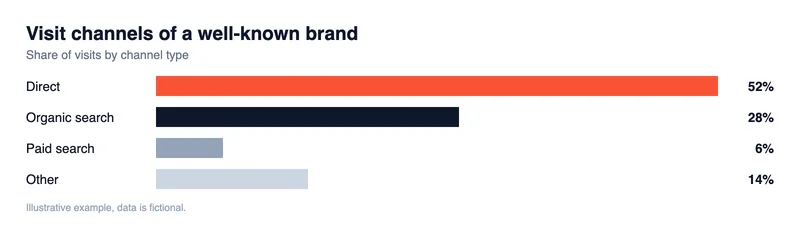
Two bridge metrics connect the brand and performance worlds. The first is the number of branded searches, which you can see in Google Search Console and in the search terms reports of Google Ads, and which tends to rise after a media flight. The second is the share of direct visits. In Google Analytics 4 the Direct channel is what is left when the source is "(direct)" and the medium is "(none)" or "(not set)", so it mixes typed addresses and bookmarks with untagged links, which makes it a rough signal, not a precise one. For a well-known brand it can still make up half of all visits, as in the illustrative channel chart below.
Plan one shared budget with explicit shares: how much goes to building awareness, how much to capturing demand and how much to retention. For scale, Gartner's 2025 survey of 402 marketing leaders, mostly at companies with more than $1 billion in revenue, puts the average marketing budget at 7.7% of company revenue, and paid media at 30.6% of that budget (2.4% of revenue). The 2026 edition, as reported by Communicate Online, shows 7.8%. As a purely illustrative calculation, a company with $2 billion in revenue would be looking at a budget in the neighborhood of $154 million at 7.7%, and the real number can sit well above or below that average. Time the media flight with performance: when branded searches climb, search and shopping campaigns must be ready to absorb that demand without hitting daily caps.
How do you protect branded demand from aggregators and competitors?
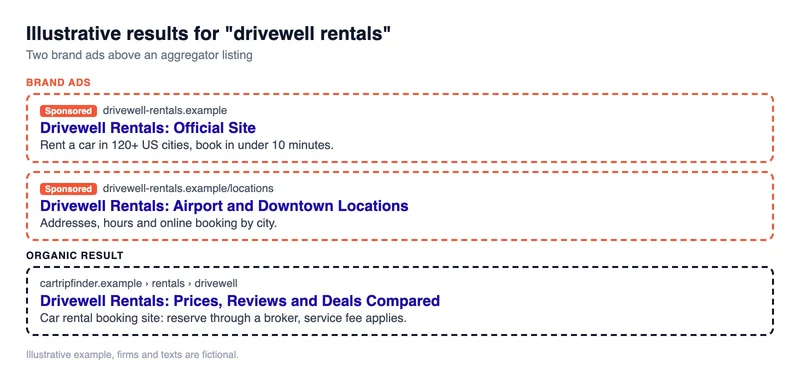
Branded searches usually bring a corporation cheap, high-converting traffic, and everyone wants a piece of it. Search results for a large company's name show aggregators, resellers, partners running their own campaigns and direct competitors. If the brand does not hold the top of the page itself, some customers go to a middleman who charges a commission, or to a rival. In the illustrative results below for a car rental brand, the two top spots are the brand's own ads, and the free result under them belongs to a booking aggregator.
Google Ads follows the same logic. A campaign on your own brand terms is usually inexpensive because the ad matches the query exactly, and it holds the top of the page. What you cannot do is stop others from bidding on your name. Google's trademark policy says it does not restrict the use of trademarks as keywords. It does restrict ad text that uses a trademark in a confusing or misleading way, and a trademark owner can file a complaint through Google's form, which Google accepts against specific advertisers identified by their URLs. Whether a competitor's ad crosses a legal line is a question for your trademark counsel, not for the ad account.
A similar fight happens on maps and in directories. In the illustrative example below, a competitor's sponsored listing sits above your branch locations: the person searched for your company and saw the neighbor first.
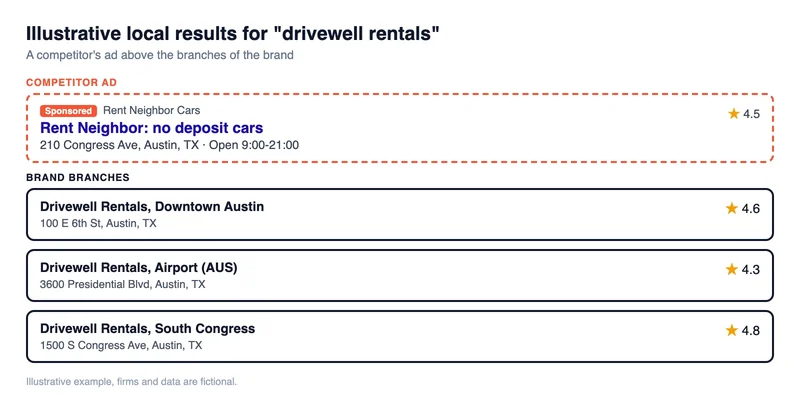
In the US the same role belongs to Google Maps and Business Profiles, Yelp, Apple Maps and industry directories, so brand profiles there should be complete and checked regularly for whoever shows up next to you. Branded results also work as a reputation storefront: the person sees stars before the click. In the illustrative example below, the rental company's app shows a 4.7 rating from more than 41,000 reviews.

A minimum brand-protection kit for a corporation looks like this:
- a campaign on your own brand terms in Google Ads with its own budget;
- a weekly check of who else shows up for the company and product names;
- complete brand profiles in Google Business Profile, Apple Maps, Yelp and industry directories, with current contact details;
- monitoring of reviews and user-made video with a response policy;
- written agreements with dealers and partners about which queries they may advertise on;
- a check of how AI assistants and AI Overviews describe the brand.
The last item is quickly becoming mandatory: some people ask an AI assistant about a company first and only then go to search. A tool for monitoring brand visibility in AI answers helps check those mentions.
Locations and regions: what the center owns and what goes local
If the corporation has branches, stores or dealers, local search becomes part of brand search. People look for the company near them and compare locations by rating and number of reviews: in the illustrative list below, branches of one bank in Austin range from 4.3 to 4.8 stars.
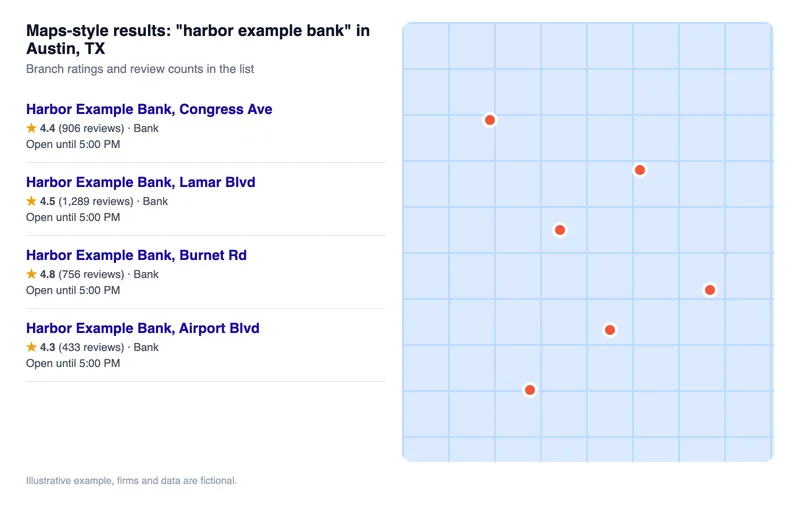
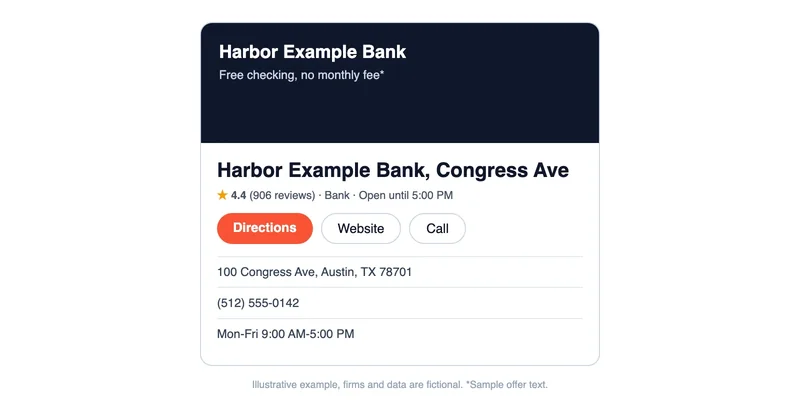
The center is in charge of standards: one business name, brand photos, a description template, review-reply rules and access to the accounts. The branch handles what only it knows: opening hours, a working phone number, local offers and reply speed. Google makes the center's job easier at scale: with 10 or more locations of the same business you can request bulk verification and upload a spreadsheet of locations instead of verifying each one. A complete branch profile carries a logo and photos, rating, hours, directions and website buttons, address and phone.
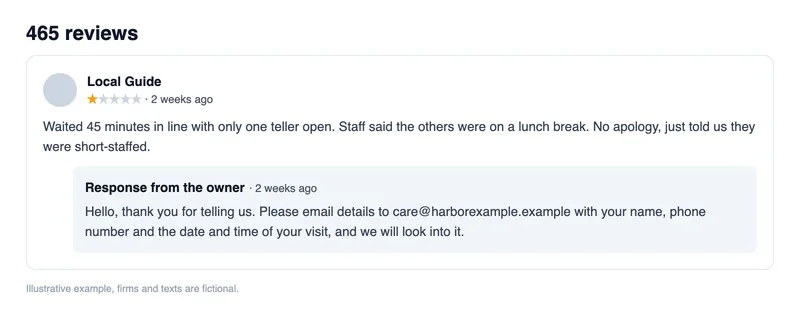
At network level, reviews turn into a stream one manager cannot handle. The center usually sets templates and response times, and branch managers answer on the company's behalf. Google lets verified owners reply to reviews, shows the reply publicly under the review, and also lets owners flag reviews that break its content policies.
A common mistake in corporations with branches: every location runs its own ads on the brand name in its own city, and the center's campaigns and the branches' campaigns bid against each other for the same query, pushing up each other's click cost. It is more reliable when the center runs the brand campaigns with regional settings, and the branches advertise local services and offers.
ABM: marketing for a list of named companies
When a corporation's customers are large companies themselves and a deal takes months, mass channels bring plenty of irrelevant contacts. ABM (account-based marketing) flips the funnel: first you choose the companies the business wants, then find the people who influence the decision in each, and build touches personally for them.
Platforms support this directly. LinkedIn, for example, lets you upload a company list as a CSV and target ads at the people who work there, with a minimum list size and matching by company name, website or page URL.
A vendor case study shows the mechanics. In a case published for the ABM platform RollWorks, the B2B data company Bombora refined its ideal customer profile, aligned sales and marketing, brought intent data into the platform and built high-intent audience segments with personalized ads. The case reports a 17% higher click-through rate and a 67% higher conversion rate than non-intent display campaigns, and a tenfold rise in influenced pipeline at the same marketing spend. It is a vendor-published case, so read the numbers as the vendor's own claims, not as a benchmark.
Two conclusions follow for a corporation. ABM metrics are different: engaged accounts from the list, meetings and deal speed instead of lead counts. And ABM needs marketing and sales working together from day one, because the sellers already have the account list and know the buying committee.
For a fuller view of selling to business buyers, see our guide to digital marketing for IT companies, which covers a long B2B funnel and the buying committee in more detail.
Martech stack and data: how do you connect CRM, analytics and ads?
A large company always has more tools than connections between them. Ad accounts count clicks, analytics counts visits, the CRM counts deals, and the numbers do not match. The point of a stack is to give every customer one history: where they came from, what they viewed, what they bought and how much they brought in. A corporate stack usually has six layers:
- advertising: Google Ads (Search, Performance Max, YouTube, Demand Gen), Microsoft Advertising, LinkedIn, Meta;
- analytics: Google Analytics 4 for the site, Firebase for apps, call tracking for phone calls;
- a CRM for customers and deals, for example Salesforce or HubSpot;
- communications: email, SMS and push from one customer base;
- data: a warehouse or CDP where customer profiles from all systems are collected;
- management: a task tracker, a base of briefs and access records, and reporting for executives.
The key connection is the CRM linked to analytics and ads. In Google Ads, offline conversion import works through the Google Click ID (GCLID): the ad system assigns an ID to every click that lands on your site, you store it with the lead in your CRM, and send it back when the lead turns into a sale. Google now points advertisers to enhanced conversions for leads as the easier route, which adds user-provided data such as email addresses, and says advertisers saw a median 10% increase in conversions with first-party data. Google also notes that these uploads move to the Data Manager API starting June 15, 2026, so ask your engineers to check the integration now.
After the upload, deal stages become goals for bidding: a qualified lead, a signed contract, a paid invoice. Without that link, an ad that brings 100 leads looks the same as one that brings 100 leads that never buy.
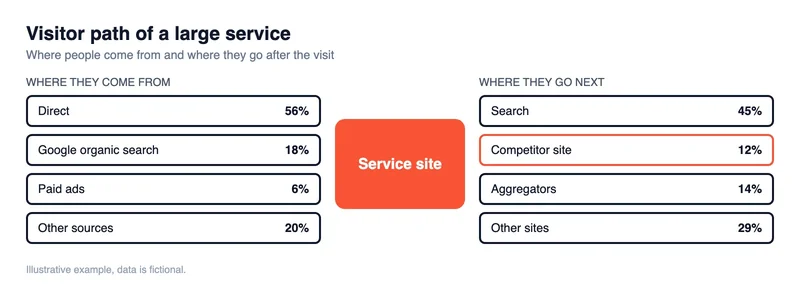
When the data is connected, you can also see what happens before and after a visit. The illustrative diagram below shows where people come from before landing on a large service's site, and where they go next, including to competitors.
The more systems you run, the stricter your data rules must be. In a corporation access is granted by role, every account and export has an owner, and a vendor gets exactly the rights its task needs and loses them when the contract ends.
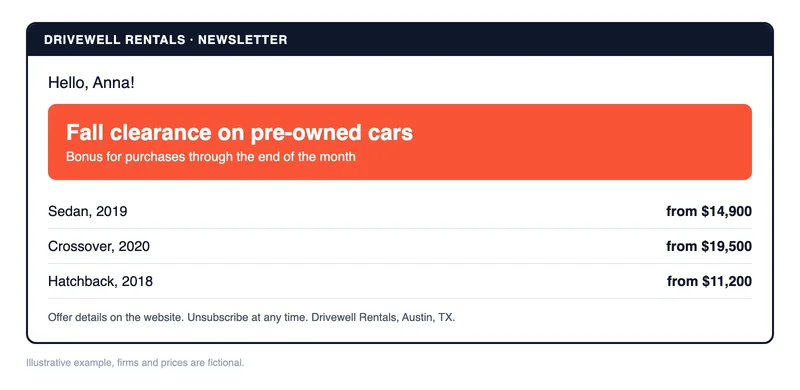
Communications run from the same base. A promotional email to customers with a seasonal offer and a personal greeting remains an inexpensive repeat-sales channel.
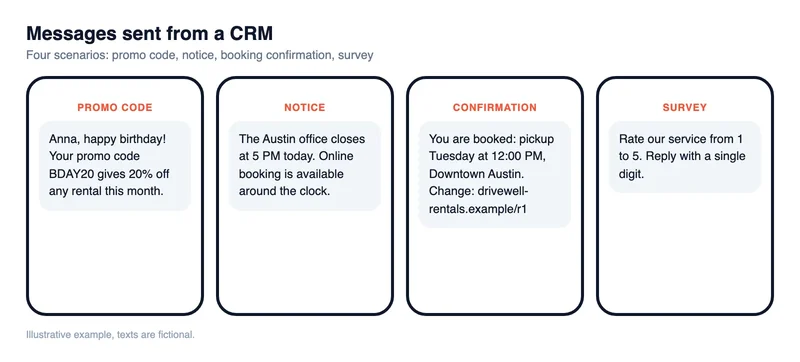
SMS and push messages cover service scenarios: a promo code for a returning customer, a notification, a booking confirmation, a short quality survey.
Attribution and marketing mix modeling
Click-based attribution undercounts brand media and overcounts the last click, and browser and consent limits keep shrinking what it can see. Large advertisers add marketing mix modeling (MMM), which estimates each channel's contribution from aggregate spend and sales data without user-level tracking. Google's open-source Meridian is one example: it supports budget optimization, reach and frequency analysis for video, and calibration with geo experiments. Use MMM for yearly budget splits and click data for weekly campaign decisions, and check both against real revenue in the CRM.
Privacy and accessibility: the rules your stack has to follow
The US has no single federal privacy law for marketing data, so a corporation works with a patchwork. California sets the pace: the California Attorney General's CCPA page lists the right to know, delete, correct, opt out of sale or sharing, and limit use of sensitive data, and says businesses must honor Global Privacy Control as a valid opt-out signal. It lists coverage thresholds that include annual gross revenue above $25 million, so most large companies are in scope. Other states have their own laws: a 2026 law firm review counts 20 states with comprehensive consumer privacy laws, with Indiana, Kentucky and Rhode Island added on January 1, 2026, and notes that updated California regulations took effect that day. Treat the rules as a baseline for the whole company and have counsel confirm what applies to each state you sell in.
For your stack, this turns into concrete tasks. Set up consent signals so tags behave by user choice: Google's consent mode defines consent types such as ad_storage, analytics_storage, ad_user_data and ad_personalization, and has a basic mode that blocks tags until the visitor chooses and an advanced mode that sends cookieless pings while consent is denied. Keep a list of every pixel and vendor that touches customer data, and make sure opt-outs reach the CRM and email platform too.
Accessibility belongs on the same checklist. The Department of Justice's web accessibility guidance says the ADA applies to the goods and services a business offers on the web, and that the Department has no regulation with detailed technical standards for it. It points to WCAG as helpful guidance, and a separate 2024 rule covers state and local governments. Most companies use WCAG 2.2, the W3C Recommendation with three levels (A, AA, AAA), as their working standard, usually aiming for AA. Put it into landing page templates, forms and PDF files, and into vendor contracts for creative and web work.
Teams and vendors: who owns what
Disconnected teams remain the main disease of corporate marketing. Every department protects its own numbers: the media team reach, the performance team cost per lead, sales its revenue plan. Vendors add another layer: the paid search agency has its own report, so does the social agency and the web developer, and someone has to merge them by hand.
Marketing's closest partner in a corporation is the sales department: it depends on the flow of leads and is first to see which ones become deals. Nearly as much time goes to legal and finance. Every ad, promotion and email passes legal review, contracts and invoices go through accounting, and if legal learns about a campaign the day before launch, the launch slips.
A responsibility matrix removes most of these conflicts: for each area, write down who decides, who does the work, who approves and who receives the report. Internal teams and vendors go into one table, and the "whose task is this" argument is settled before launch.
| Area | Decides | Does the work | Approves | Gets the report |
|---|---|---|---|---|
| Brand platform and creative | CMO | Brand team, creative agency | Legal, executives | All teams |
| Brand media | Brand lead | Media agency | Finance | Performance team |
| Search and performance | Head of digital | Performance team, agency | Finance | Sales |
| Website and SEO | Head of digital | Product team, SEO specialists | IT, legal | Marketing, sales |
| CRM, data and privacy | Marketing with sales | Analysts, CRM team | IT, security, privacy counsel | Executives |
| Reviews and reputation | Communications team | Support, location managers | Legal | Marketing |
For vendors, a simple rule works: every contract has one internal owner who sets tasks, accepts reports and answers for the result. Access to ad accounts, tags and data stays with the company, and the vendor works inside it with granted permissions. Reports from all agencies go into one format with shared metrics, otherwise you cannot compare channels.
The in-house or agency question has no universal answer. Gartner's 2025 survey found that 39% of CMOs planned to cut agency budgets and 22% said generative AI had reduced their reliance on external agencies, with the usual savings moves being to drop unproductive agency relationships and streamline rosters. A split that holds up in practice: keep strategy, the brand platform, data and account access inside, and outsource work with narrow expertise or peak load, such as video production, media buying, site development and specific ad accounts.
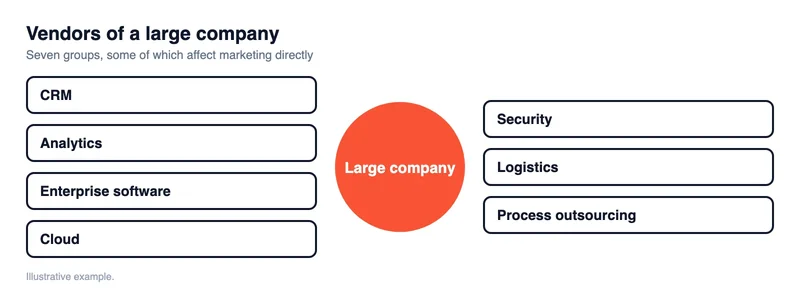
A corporation also has far more vendors than the marketing department does: CRM, analytics, enterprise software, cloud, security, logistics, process outsourcing. Some of them affect marketing directly, so IT and security belong in the matrix, and procurement will ask for security evidence. A SOC 2 report, an examination of a service provider's controls against criteria such as security, availability and privacy, is a common request when you buy a martech tool or select an agency that will touch customer data.
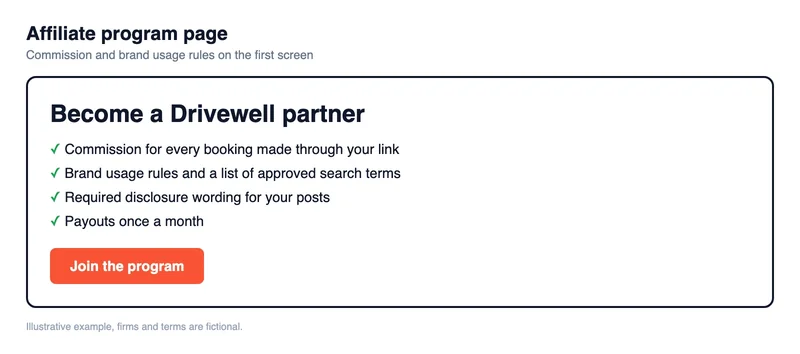
Affiliate partners are a separate type: bloggers, review sites and affiliate networks paid for every purchase through their link. They need their own rules: how to use the brand and on which queries they may advertise. The FTC's endorsement guidance also applies: its FAQ on endorsement guides says a company is ultimately responsible for what others do on its behalf, that affiliate links need a clear disclosure near the recommendation, and that advertisers should train and monitor the people who promote them.
How do you budget corporate marketing and measure returns?
There is no ready-made percentage of revenue for a corporation. The Gartner averages above are a reference point, but the budget depends on competition in your industry, the year's goals and channel costs: launching a product in a new market costs more than defending share, and brand media needs different sums than search. It is more reliable to build the budget from company goals: how many leads, sales and impressions you need, and what each unit has cost in past data.
Metrics are easiest to keep on three levels:
- brand: awareness and consideration, the number of branded searches, share of direct visits;
- performance: cost per lead, conversion rate, ad spend as a share of revenue;
- business: revenue, margin, repeat purchases and customer lifetime value.
Executives look at the third level and teams work with the first two, so show the link between levels in every report: how the rise in branded searches affected cost per lead, and how cost per lead affected revenue.
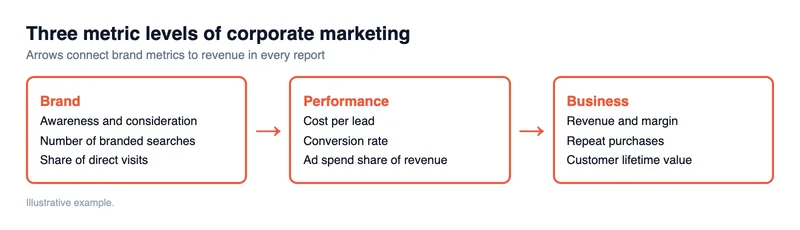
Compare channels by the cost of a business result: a lead, a deal, a paid order. Without the CRM tied to analytics, brand media looks expensive and branded search looks unreasonably efficient, because it harvests demand that other channels created.
One budget line is for channels that pay back over years. Organic search traffic to a large site builds up over years, and such an asset does not vanish the day you switch ads off, so plan SEO in a corporation as a multi-year investment. AI answers now sit on top of search results too, which is one more reason to track brand visibility there.
Enterprise digital audit: a first-quarter plan
You cannot rebuild everything at once in a large company, and you do not need to. It is easier to audit the handoffs and, over one quarter, close the gaps where the company loses the most money.
Order matters: data and owners first, new channels after. Until CRM orders are linked to advertising, every decision about shifting budget is made on feel.
- Collect the company's goals for the year and write down what each expects from digital.
- List every channel, ad account, tag and vendor with owners and access.
- Check branded results in Google Search, on maps and in directories: who shows up for the company name.
- Set up passing the click ID into the CRM and uploading deal stages back to Google Ads.
- Merge agency reports into one format with metrics from all three levels.
- Fill in the responsibility matrix and agree on it with sales, legal and IT.
- Check consent settings, opt-out handling and accessibility on the main templates.
- Plan a media flight together with performance and measure the rise in branded searches.
- If you sell to large customers, pick a short list of accounts for an ABM pilot.
After a quarter, leadership gets a picture it usually does not have: what a customer costs in each channel, who owns each area and where the company loses demand. From there the work becomes an ordinary planning cycle where brand, performance and data are discussed at one table.
Frequently asked questions
What is corporate marketing in plain words?
Corporate marketing promotes the company as a whole: its brand, reputation and relationships with customers, partners, investors and employees. Product marketing is responsible for sales of a specific product. In digital, corporate marketing combines brand communications, advertising, data work and vendor management into one system with shared goals.
What structures does a marketing department have in a large company?
The most common are a functional structure, where teams split by task (brand, digital, analytics, communications), a product structure with a team for each product, and regional or market structures split by customer segment. Large companies usually mix them: analytics and brand stay central, while product and regional teams get their own budgets and goals.
What technology is used in marketing?
Marketing technology, or martech, covers ad accounts, analytics systems, CRMs, email and messaging platforms, a CDP for customer profiles, call tracking and automation tools. In a large company the integrations determine the value: until deal data reaches analytics and ads from the CRM, each tool works on its own and shows only its part of the picture.
When does it make sense to outsource marketing?
Companies usually outsource tasks that need narrow expertise or have peak load: creative and video production, media buying, site development, specific ad accounts. Strategy, the brand platform, data and account access are better kept in-house, and every vendor should get an internal owner who sets tasks and accepts the results.
What is brand performance marketing?
It is an approach where brand and performance advertising are planned together and judged on shared results. Brand campaigns grow awareness and branded searches, and search and shopping campaigns capture that demand. You judge it by growth in brand metrics and by the cost per lead among people who saw the brand ads compared with those who did not.
Дата публикации:
Задать вопрос
Вопросы и ответы
Пока нет опубликованных вопросов. Задайте первый — после модерации он появится здесь.
Вам также может понравиться
Все статьи
IT companies
Marketing for IT services companies: how to win projects in the US
How US IT services firms win clients: buying committees, case studies, Clutch and G2, LinkedIn, SOC 2 pages, CAN-SPAM, cloud marketplaces and ABM.
Local business
Local SEO: How to Get Your Local Business Into Google Maps and the Local Pack
US local SEO: Google Business Profile, local pack, Apple Maps, Bing, Yelp, NAP and citations, location pages, reviews rules and a three-month plan.