

SEO for Fintech Companies: Win Search Traffic and Customer Trust in the US
Fintech SEO does two jobs at once: it brings people from Google to your product pages and it answers the fear of handing a service their money and data. We cover queries, product and comparison pages, trust signals, app and web together, technical basics and the US rules for financial content (CFPB, FDIC, FINRA, SEC, FTC).


How is fintech SEO different from promoting a regular website?
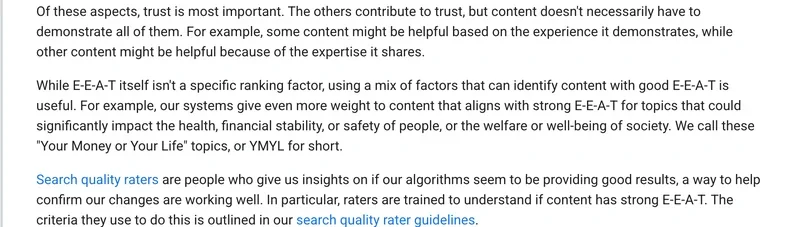
Financial services are a YMYL ("Your Money or Your Life") topic. A mistake on such a page can cost the reader money, so Google holds it to a stricter standard than a page about phone cases. In its helpful content guidance, Google says its systems give extra weight to strong E-E-A-T (experience, expertise, authoritativeness, trustworthiness) on topics that can affect a person's financial stability, and that trust is the most important of the four. Searchers and raters want to know who stands behind the service, under what authority it operates and where the numbers come from. Until a page answers those questions, even a strong product page loses to a more cautious result. The same logic drives SEO for law firms, another YMYL niche.
The second feature is the makeup of the results page. On broad money queries ("best business checking", "savings account") the top of Google is usually crowded with large publishers, comparison sites and incumbent banks. We have no reliable share to quote, so look at the live results for your ten main terms before you plan anything. If page one is all comparison sites, a young fintech is better off competing for narrow phrases, brand demand and informational questions where it can be the primary source.
The third is that the product lives in an app and on the web at once. A person finds the service in search, installs the app and returns through notifications, while pricing, disclosures and help stay in the browser. SEO owns the stretch where the customer is still deciding whom to trust with their money, so every page should work as a short, honest conversation about terms. In the US there is one more reader, the regulator, and the last section lists the rules that matter most.
Fintech keyword research: which queries to collect
Broad words such as "fintech" and "financial technology" have large volume, but the results are definitional: encyclopedias, news and glossaries. Growth comes from phrases tied to a customer's task: "business checking for freelancers", "expense tracking app", "merchant account for an online store", "how to send money abroad".
Build the core from live data: Google Search Console queries, autocomplete, the "People also ask" box and questions from sales leads. A fintech has extra sources: support tickets, search inside the app and the wording of App Store and Google Play reviews. That is how you find words that keyword tools never show. Then sort queries by intent and give each group its own page, so that one URL does not try to answer everything and win nothing.
| Query type | Example | Page | Must have |
|---|---|---|---|
| Informational | how to teach a teenager to manage money | Article or guide | Named author, review date, link to a fitting product |
| Category | teen debit card, merchant services for small business | Category page | Comparison of options, terms, path to the product |
| Commercial | open business checking account online | Product page | Pricing, disclosures, application form, answers to objections |
| Brand | brand name plus reviews, login, "is it legit", "FDIC insured" | Home page, help center, security page | Company details, partner bank, contacts, sign-in |
| Service | how to set up direct deposit | Support section | Step-by-step instructions, link to chat |
Brand queries deserve separate attention. People add "reviews", "login", "scam", "complaints" or "is it FDIC insured" to a company name, and the answer should sit in your own results: a help center, a security page, public replies to reviews. The CFPB Consumer Complaint Database is public too: complaints are published after the company responds, confirms a commercial relationship or after 15 days, and the database generally updates daily. In August 2026 the CFPB stopped publishing complaint narratives but still collects complaints, so answer each one through the company portal and check what the database shows about you.
If you serve different rules by state, add state pages instead of city pages: which products are available, which licenses you hold and which disclosures apply. For physical offices, see our guide to local SEO.
Product and comparison pages: what to build them from
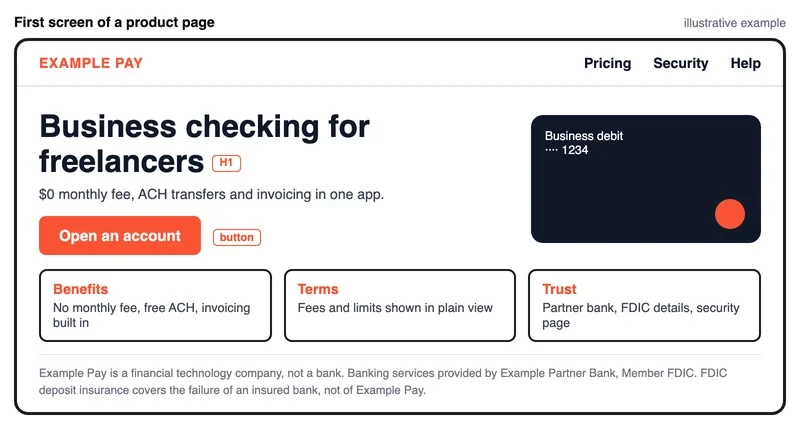
A product approach to SEO means one page per customer task. Instead of a generic "Our services" page, make separate ones: "business checking for freelancers", "merchant account for online stores", "debit card for teens". Each covers its own intent, leads to one action and gets its own H1 with the main query. Every block of the page answers a specific doubt, and the set is worth checking as a whole:
- First screen: who the product is for and what it gives, one visible action button.
- Benefits and features: specifics instead of slogans, such as setup time, limits and integrations.
- Pricing and terms: prices, fees and restrictions in plain view, with no asterisks in small print. Rates (APR, APY) follow the advertising rules below.
- Security and documents: legal entity, partner bank, licenses or registrations, how data is protected.
- Reviews and case studies: real stories that can be checked on outside platforms.
- Integrations and partners: which accounting systems, payroll tools and platforms the service works with.
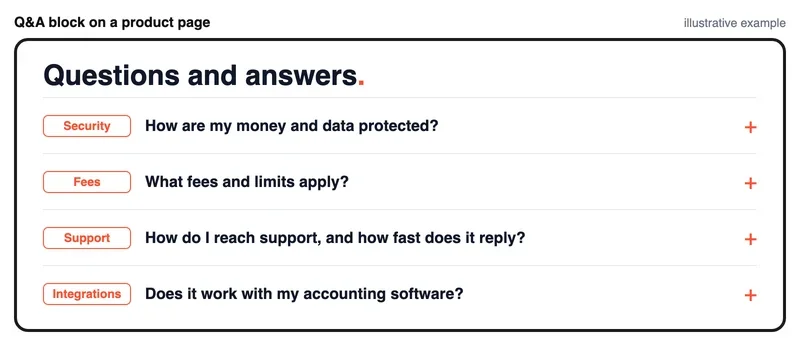
- Questions and answers: security, fees, support, compatibility.
- Contacts: phone, email, chat and support hours.
The questions block is best built as an accordion, as in the mockup below. Write it for readers: Google's changelog says the FAQ rich result stopped appearing in Search on May 7, 2026, so do not expect a snippet from it (Google Search documentation updates).
A page works when the main things are visible in seconds: the headline, the button and the key benefits stand out, there is enough white space, and everything reads on a phone without zooming. The mockup shows a typical first screen with the "not a bank" line in the footer, which we return to below.
Basic markup is simple: the title tag holds the main query and what makes the product different, the meta description promises a concrete benefit without loud words, there is one H1, the URL is readable and images have descriptive alt text. Internal links lead from articles to the product, and from the product to documents and help.
When prices are calculated per customer, build a calculator for the monthly payment, the cost of coverage or the yield on a deposit. It replaces long text, raises engagement and earns links. If it shows APR or APY, its outputs are advertising and fall under the rules in the legal section.
Comparison pages are a separate type. People search "checking account vs savings account" or "fintech app vs bank", and there is no reason to hand those queries to aggregators. An honest page compares your product with alternatives by the customer's criteria, states the date the terms were checked and links to documents. Take competitor numbers only from public sources and recheck them before publishing.
Which trust signals does a financial site need?
A page where a person enters data or pays must answer three questions: who are you, under what authority do you operate and what happens to my information. On the About page put the full legal name, the state of incorporation, the address, the names of executives and links to your documents.
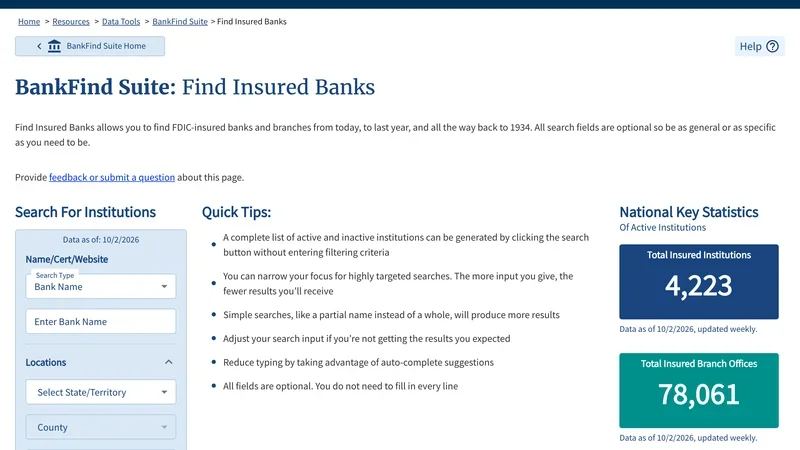
Authority to operate deserves a direct statement, and in the US there is no single register for it. A bank can be checked in the FDIC's BankFind Suite, which lists FDIC-insured banks and branches. A broker-dealer or investment adviser can be checked in FINRA's BrokerCheck, a free tool for researching the background of brokers, advisers and firms. A money transmitter or other money services business must, with a few exceptions, register with FinCEN within 180 days of being established and renew every two years (FinCEN registration page), and state money transmitter and lending licenses are separate. Customers will check you in these places, so give the license numbers and links yourself.
If your service is not a bank, say who provides the banking: name the partner bank and write the "not a bank" line. Under the FDIC's rule on false advertising and misrepresentation of insured status (12 CFR 328, subpart B, effective April 1, 2024, compliance required by January 1, 2025), a non-bank that makes a statement about deposit insurance omits material information if it fails to state, clearly and prominently, that the company is not a bank with FDIC coverage of its own, and that FDIC insurance only matters if an insured bank fails. It must also identify the insured banks where customers' deposits may be placed. Where deposits and non-deposit products sit close together, the page must label the non-deposit products as uninsured by the FDIC, not deposits and able to lose value, and a statement about pass-through coverage must say that conditions apply. The FDIC adds in the preamble that a hyperlink to the disclosure generally does not meet the clear and conspicuous standard, so put the words next to the claim (final rule in the Federal Register).
If a page says "FDIC insured", the same screen should say who the bank is and that the fintech itself is not one.
Our summary of the FDIC rule on insured-status statements (12 CFR 328.102(b)(5))
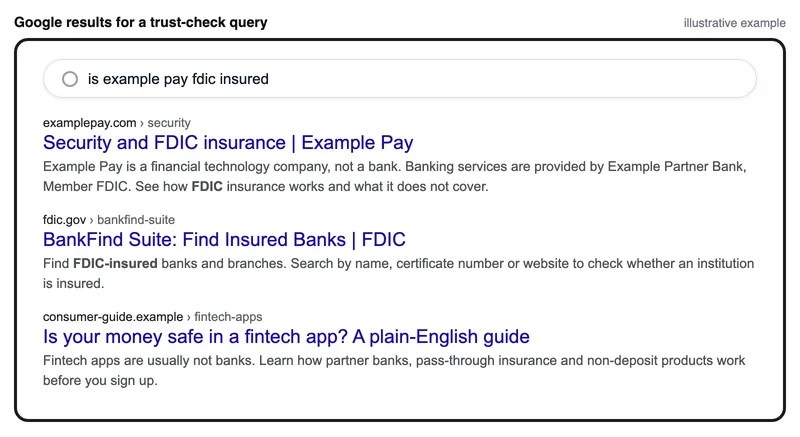
For SEO this means the line appears wherever the claim does: hero, pricing, footer, the title and description if they mention insurance, the store listing and ads. Do not use FDIC logos or terms in a way that implies the fintech itself is insured. People do search this: "is example pay FDIC insured" should return your own security page next to the regulator's lookup, not only third-party guesses.
Expertise is shown by authors and sources. Google's helpful content guidance says content is easier to trust with clear sourcing, evidence of the author's expertise and an author page or About page, and it warns that made-up author profiles are a form of deception. For a fintech, an article has a named author with a real title, such as a CPA, an attorney or a compliance officer, a "terms checked on" date, and links to the law and official documents.
Security and data practices complete the picture. The PCI Data Security Standard (PCI DSS) applies to organizations that hold, handle or send cardholder data, or whose systems could affect its security; scope depends on how you take payments, so ask your processor or assessor and claim compliance only when it is validated. A non-bank financial company under FTC jurisdiction must also follow the FTC Safeguards Rule, which requires, among other things, multi-factor login for anyone who can reach customer information and a notice to the FTC within 30 days of discovering a breach affecting at least 500 consumers. Describe your practices on a plain-language security page (encryption, access controls, independent audits such as SOC 2 if you have them), publish a clear privacy policy and serve every page over HTTPS, without details that would help an attacker.
App and website: how not to lose search
A store listing works as a second landing page with its own limits. Apple allows an app name of up to 30 characters, a subtitle of up to 30 and up to 10 screenshots, and the first one to three screenshots appear in search results when there is no app preview (Apple product page guide). On Google Play the title is limited to 30 characters, the short description to 80 and the full description to 4,000 (store listing help). The name and the first line must carry the main meaning of the product.
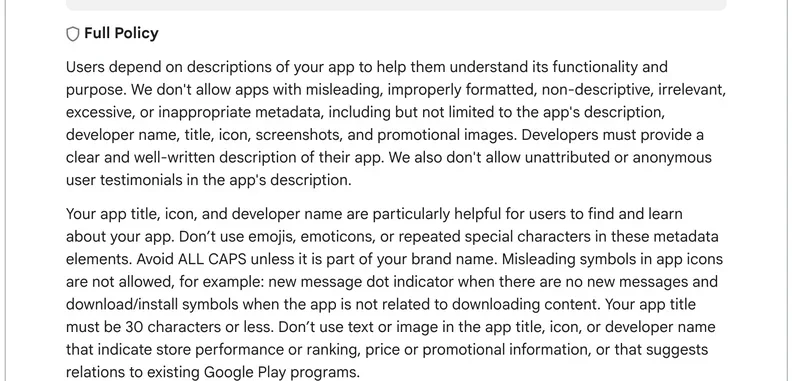
Store rules are stricter for finance, so the listing is part of your compliance surface. Google Play's metadata policy bans unattributed or anonymous user testimonials in the description. Its Financial Services policy requires every developer to complete a financial features declaration, and personal loan apps must disclose all terms, including the maximum APR and the minimum and maximum repayment period, with no US loans at 36% APR or higher. Apple's App Review Guidelines say apps in highly regulated fields such as banking should be submitted by the legal entity that provides the service, trading and investing apps by the licensed financial institution, and loan apps must disclose all terms, including APR and the payment due date.
Add trust data to the listing: a developer name that matches your legal entity, the partner bank line and a link to the website with documents, because people choosing an app for money check who published it. Do not require a rating or review to unlock features.
The website is the bridge. Build an indexable app page with links to both stores, a QR code, use cases and screenshots; it answers "download the app" queries and helps you capture brand demand before imitators do. Configure links from emails and ads so that the screen opens inside the app if it is installed, and the web page with the same content opens otherwise. On Android, Android App Links verify the link between your app and your website so web links open straight in the app without a chooser dialog. On iOS the same job is done by universal links, which rely on an association between the app and the site. Search brings the person to the listing, the listing sends them back for documents, and data about both parts goes into one analytics view.
Technical foundation: accounts, indexing, speed, documentation
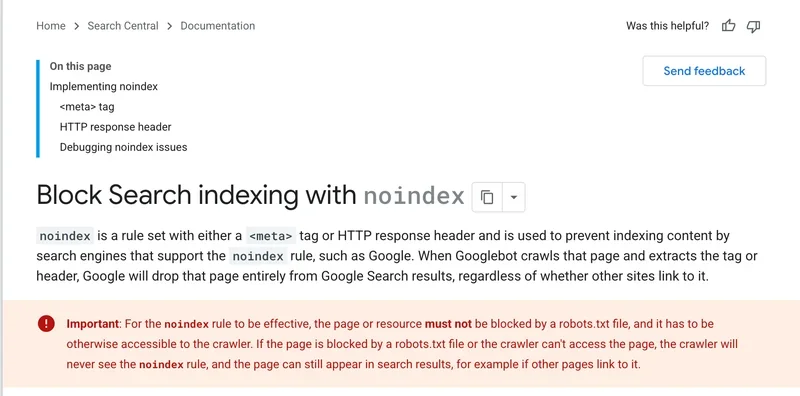
Keep customer accounts and service areas out of search carefully. Pages behind a login are not reachable by Google anyway. Pages that crawlers can see but should not appear in results, such as thank-you pages, internal search results and duplicates, should carry a noindex meta tag and stay crawlable. Google's noindex documentation warns that if robots.txt blocks the page, the crawler never sees the rule, so the page may stay in results, for instance if other pages link to it. Google's robots.txt introduction adds that the file is mainly for managing crawl load and is not a mechanism for keeping a page out of Google.
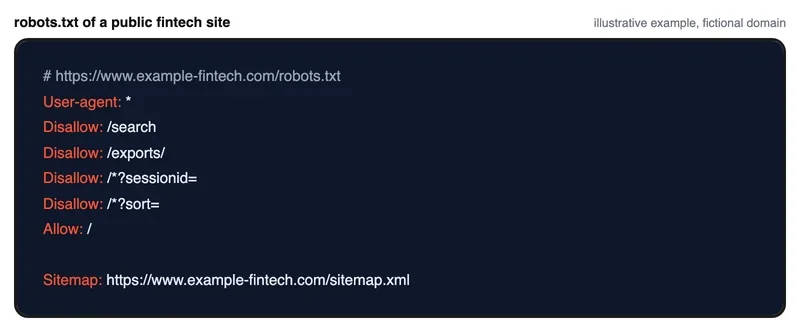
That gives a simple order. Anything behind authentication stays closed on its own, pages you do not want shown get noindex and stay open to crawling, and robots.txt is for technical paths: internal search, exports and parameter URLs. The example below blocks internal search, export files and session and sort parameters, and points to the sitemap. For the wider topic, see our guide to website indexing.
The next layer is duplicates. Calculators, pricing tables and filtered pages easily produce dozens of parameter URLs. Google's canonicalization guide ranks the signals: redirects and rel="canonical" are strong, sitemap inclusion is weak. Pick one canonical address, normalize tracking parameters and keep a current sitemap. Google's sitemap guide adds that Google ignores priority and changefreq, uses lastmod only if it is consistently accurate, and limits a sitemap to 50 MB or 50,000 URLs. A 404 page should not be a dead end: leave a search box, product links and support contacts on it.
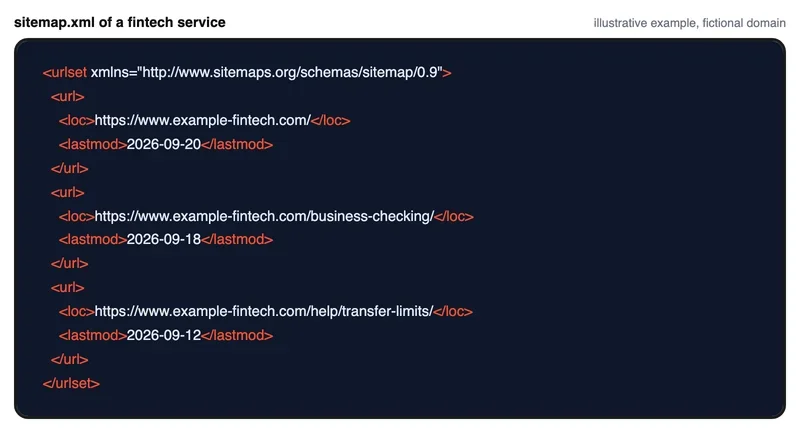
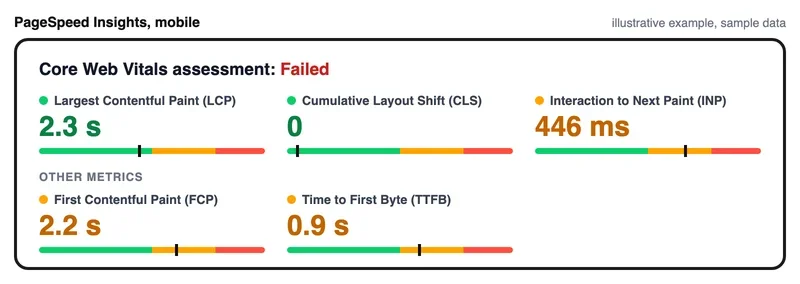
Fintech sites are often built on JavaScript frameworks, and the check is simple: open a product page with scripts disabled and confirm that the text, terms and links are there. Google's JavaScript SEO basics explain that Google renders JavaScript with an evergreen Chromium but will not render it on blocked pages or from blocked files. Then check mobile speed. The Core Web Vitals targets are an LCP of 2.5 seconds or less, an INP of 200 milliseconds or less and a CLS of 0.1 or less, at the 75th percentile of page loads. In the sample report below, LCP and CLS are green and INP is orange, so the assessment fails until INP improves.
For B2B fintech, API documentation is a separate asset. A developer who searches "create a payment API" or "verify webhook signature" lands on a page with the method and a code sample, without any ad. Keep the docs indexable, version them with a canonical URL pointing to the current version, add a sandbox with test keys and publish clear pricing. How buying committees evaluate vendors is covered in our article on enterprise digital marketing.
Use structured data for a concrete job. Google's Organization markup has no required properties but recommends as many relevant ones as you can, and some influence the logo shown in results. Rich result support changes, as the FAQ example shows, so treat a snippet as a bonus.
Links and reputation
A fintech's link profile grows in three ways. The first is what you place yourself: LinkedIn and industry directory profiles, your store pages and, for offices, a Google Business Profile, with company details matching everywhere.
The second is what you ask for: expert columns and quotes in trade publications and podcasts, industry rankings and studies, and partner pages that list you as an integration. Link exchanges are acceptable only between services that are really connected. Google's spam policies treat buying or selling links for ranking, and excessive link exchanges, as link spam.
The third is earned links, where fintech beats many niches: interactive calculators and trackers, studies based on anonymized service data, guides such as "how to recognize a payment scam", and infographics with clear numbers. Start by checking which pages bring links to competitors and build something more useful.
Reputation affects results directly, and reviews must be real. The FTC's rule on consumer reviews and testimonials, in effect since October 21, 2024, targets fake or false reviews, payment for reviews conditioned on a sentiment, undisclosed insider reviews and review suppression, and lets courts impose civil penalties when violations are knowing (FTC questions and answers). Ask for feedback through in-app prompts, emails and post-service surveys on the platforms your customers use: Google, the App Store, Google Play, Trustpilot, the Better Business Bureau and, for B2B products, G2. Check the results for "brand reviews" regularly, reply to criticism on the substance and in public without exposing account details, and never accuse a reviewer of something you cannot prove.
How to measure SEO results in fintech
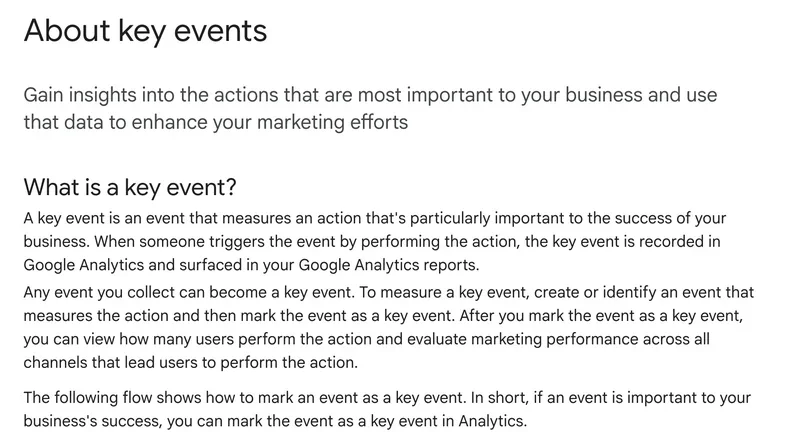
Rankings remain a guide, but customer actions are the result. In Google Analytics, a key event measures an action that is particularly important to your business, and any event you collect can be marked as one. For fintech, set up a sequence: a view of the pricing page, a click on "Download the app", sign-up, submission of identity documents and the first transaction. Keep personal data out of analytics: Google's policy says nothing may be sent that Google could recognize as personally identifiable information, such as email addresses or Social Security numbers (Google's PII guidance).
Not every step happens in a browser. The Measurement Protocol sends server-to-server and offline events, so the first-transaction event can come from your core system and be tied to the visit source. The report then shows the share of people who reached a first transaction, not just sign-ups from search.
See which sections bring people from search. If the app download page collects the most visits and the blog is barely read, demand for the product exists and the informational layer is weak. Many exits without a second view on articles say the headline promises more than the text, and a low CTR with many impressions suggests rewriting the title and description. Google's Search Console performance report gives clicks, impressions, CTR and average position by query and page.
- Queries and impressions: Search Console: which phrases bring people and which pages get few impressions.
- Indexing: share of product pages in the index, server responses, mobile problems.
- Rankings: groups of queries by the types in the table above, not single phrases.
- Customer quality: organic versus other channels by retention and lifetime value, not only cost per sign-up.
Once a month, assemble a short report: indexing growth, visibility by query group, conversion from search to sign-up and first transaction, and review trends. If refined query groups show no movement for a quarter, revisit structure and copy before adding new pages.
Legal requirements for financial content and advertising
A page that promotes a financial service is advertising in the eyes of regulators, and several rule sets can apply at once. This is a map for the SEO and content team, not legal advice; agree final wording with counsel who knows your product and your partner bank's requirements.
| Area | Rule | What it means for pages and snippets |
|---|---|---|
| Any consumer financial marketing | UDAAP (CFPB examination procedures) | Deceptive if it misleads or is likely to mislead a reasonable consumer on a material point. The net impression counts; fine print may not cure a misleading headline. |
| Deposit insurance, "not a bank" | FDIC, 12 CFR 328 subpart B | Do not imply a non-bank is insured; name the partner bank; put disclosures next to the claim. |
| Credit advertising | Regulation Z, 12 CFR 1026.24 | State only terms actually offered; use "annual percentage rate"; stating terms such as the payment amount or finance charge triggers more required disclosures. |
| Deposit account advertising | Regulation DD, 12 CFR 1030.8 | Use "annual percentage yield"; do not call an account "free" if a fee may be charged; disclose variable rates, how long a rate is offered and minimum balances. |
| Broker-dealers | FINRA Rule 2210 | Fair and balanced; no promissory or exaggerated claims; a registered principal approves retail communications. |
| Investment advisers | SEC Marketing Rule, 17 CFR 275.206(4)-1 | No untrue or unsubstantiated claims; fair and balanced treatment of risks; testimonials and endorsements need disclosures. |
| Reviews and testimonials | FTC reviews rule | No fake, sentiment-conditioned or undisclosed insider reviews; no review suppression. |
The takeaway for SEO is practical. Before launching promotion, confirm licenses and registrations with the relevant regulators and put the numbers and lookup links on the page. Replace "guaranteed returns", "no risk", "approval guaranteed" or "free" with a description of the terms, in titles and meta descriptions too, since that is what appears in search. If the product runs on a partner bank, check whether your agreement requires the bank to review marketing copy before it goes live.
Crypto and other digital assets bring additional federal and state rules and need legal review before publishing. This article does not replace legal, financial or investment advice.
Frequently asked questions
What is YMYL and how does it relate to fintech?
YMYL (Your Money or Your Life) covers topics where an error can affect a person's money, health or safety. Financial services belong to it fully, which is why fintech pages need company details, named authors, sources and current terms: without them, search engines rank even helpful text cautiously.
What is E-E-A-T and is it a ranking factor?
E-E-A-T stands for experience, expertise, authoritativeness and trustworthiness. Google says it is not a specific ranking factor, but its systems use a mix of factors that can identify content with good E-E-A-T, and trust is the most important of the four. In practice: clear authors, sources, transparency about the organization and honest terms.
Do I have to say my fintech is not a bank?
If you make statements about FDIC insurance, yes: under the FDIC rule a non-bank must state, clearly and prominently, that the company is not a bank with FDIC coverage of its own, and that insurance only matters if an insured bank fails, and must name the partner banks that hold the deposits. Even without insurance claims, a plain "banking services provided by (partner bank), Member FDIC" line prevents confusion. Confirm the wording with counsel and your bank partner.
How do I handle reviews of a fintech company?
Collect real ratings after a successful transaction: an in-app prompt, an email or a short survey. Reply to criticism on the substance and in public, saying what has been done. Never order artificial reviews: the FTC's reviews rule lets courts impose civil penalties for knowing violations, and reputation is shaped in the end by customers and by how the company behaves.
Дата публикации:
Задать вопрос
Вопросы и ответы
Пока нет опубликованных вопросов. Задайте первый — после модерации он появится здесь.
Вам также может понравиться
Все статьи
Technical SEO
Website indexing: how it works, how to check it and how to speed it up
How Google indexes a site, how to check pages in Search Console, and how to speed it up with sitemaps, URL Inspection and IndexNow.
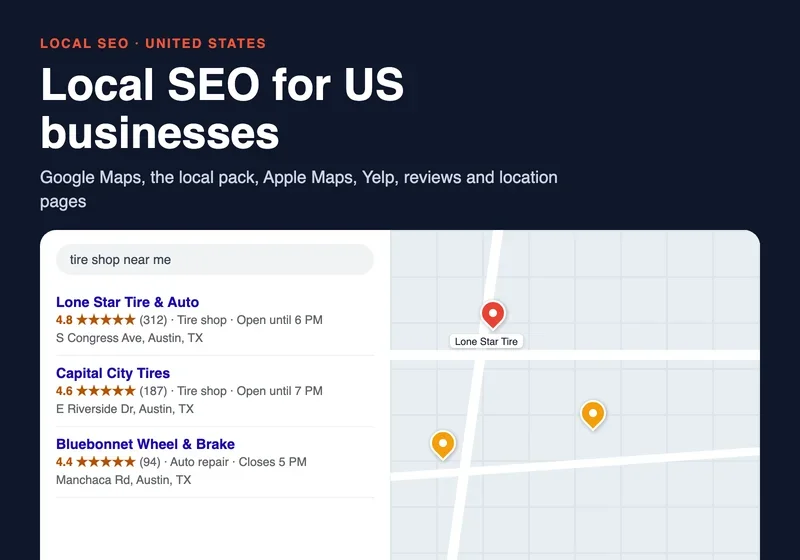
Local business
Local SEO: How to Get Your Local Business Into Google Maps and the Local Pack
US local SEO: Google Business Profile, local pack, Apple Maps, Bing, Yelp, NAP and citations, location pages, reviews rules and a three-month plan.
Law firms
SEO for lawyers: how to promote a law firm website on Google
How to promote a law firm site on Google: practice and city pages, attorney bios, bar advertising rules, reviews, Business Profile and Local Services Ads.
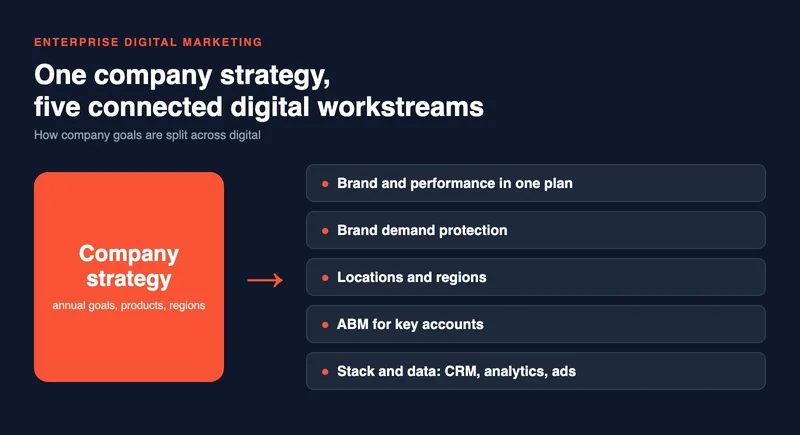
Enterprise
Enterprise digital marketing: how to build digital in a large company
Enterprise digital marketing: goals from strategy, one brand and performance budget, branded demand, ABM, CRM data, privacy, accessibility, team roles.