

SEO for lawyers: how to promote a law firm website on Google
A law firm site ranks on Google by the same rules as any other, with two differences: legal topics get extra scrutiny for expertise and trust, and state bar rules limit what you can say about results, reviews and specialties. We cover which pages to build for practice areas and cities, how to show the attorney behind the answer, how to handle reviews and Local Services Ads, and how to track results.

Why is a law firm website harder to promote than most?
People who search for a lawyer are usually under stress: a divorce, a DUI arrest, a debt collector, a dispute with an employer. A wrong answer can cost them money or their freedom, so we treat legal topics as YMYL (Your Money or Your Life) material, where accuracy standards are higher. Text that a copywriter stitched together from other sites loses to an explanation written or reviewed by a practicing attorney, even when the on-page work is perfect.
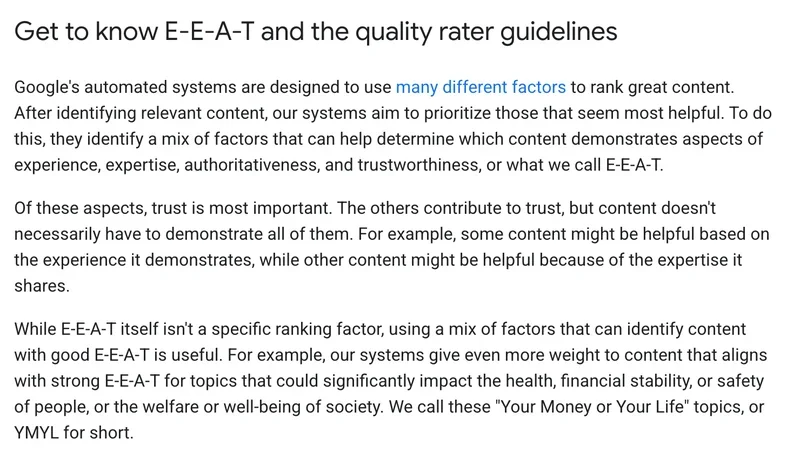
Google says as much. In its guidance on creating helpful, reliable, people-first content, Google explains that its systems look for signals of experience, expertise, authoritativeness and trust (E-E-A-T), that trust matters most, and that content on topics affecting health, financial stability or safety gets even more weight on those signals. Legal advice can affect all three. E-E-A-T is not a single ranking factor; it is a way of describing a mix of signals. The same page asks "who" created the content: pages should carry a byline where readers expect one, and the byline should lead to real information about the author. The practical takeaway is simple: a legal page should show who answers and on what basis. This is the passage:
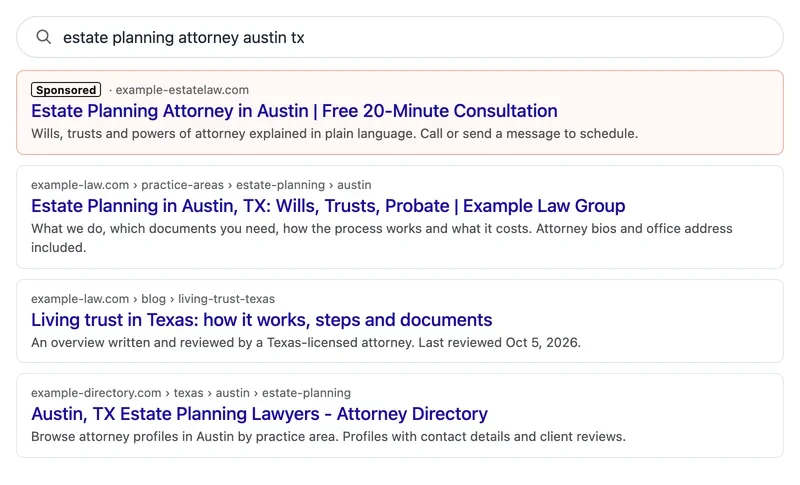
The second difficulty is competition. For searches such as "divorce attorney Phoenix," the first screen is often shared among law firm sites, lawyer directories (Avvo, Justia, FindLaw and similar), ads and the map pack. Run your own searches before you plan anything. A firm site usually finds it easier to win narrow queries that combine a practice area, a city and a specific situation.
Organic search pays back slowly: ads produce calls as soon as the budget runs, while a page that ranks for "estate planning attorney Austin" keeps working month after month without a cost per click. This article is about organic and local results, with a short look at Local Services Ads because they share the same results page.
The third difficulty is regulation. In most states a lawyer's website counts as advertising, so every claim on it falls under the state bar's rules. This article describes marketing practice, not legal advice. The rules differ by state and change often (New York rewrote its advertising rules effective June 1, 2026, and California amended its advertising statute effective January 1, 2026), so check your state's current text before you publish.
What do legal clients search for?
It is easier to build the keyword list by practice area. Family law, bankruptcy and criminal defense use different words, have different volumes and face different competitors. Inside each practice area, queries fall into four groups, and each group needs its own kind of page.
- Commercial: "divorce attorney," "car accident lawyer," "chapter 7 bankruptcy attorney." The person is ready to call and is comparing firms.
- Local: the same queries with a city, a neighborhood or "near me." Here the location of your office and your Google Business Profile decide a lot.
- Informational: "can I stop a divorce," "how is child support calculated in Arizona," "how much does a bankruptcy cost." The person looks for an answer first and picks a lawyer later.
- Navigational: a firm name or an attorney's name. Articles, referrals and local reputation produce these searches.
Keyword tools give volumes and wording, but legal queries have a trap: many exact phrases show close to zero volume. "Landlord tenant attorney Round Rock" may look like a handful of searches a month, yet together with "eviction lawyer Round Rock" and "security deposit dispute" the group brings steady traffic. Decide on a new page by the whole group, not one phrase.
Then group the phrases. Queries that return the same pages can share one page; the rest get their own. "Divorce attorney Austin" and "Austin divorce lawyer" belong together, while "divorce with a military spouse" needs a page of its own because the paperwork, jurisdiction and questions differ.
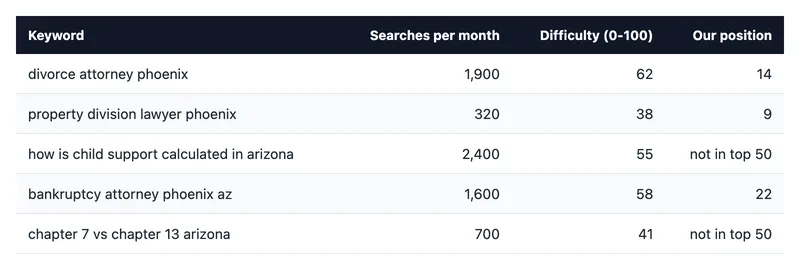
Competitors are a second source: open the sites of firms that rank for your practice areas and see which sections bring them traffic. In a keyword report, each phrase shows volume, difficulty and your current position. Set the hardest phrases aside and start where competitors are weaker.
One page for each practice area and city
A firm's home page mostly collects brand searches. Inquiries tend to arrive through pages for specific services, location pages and the contact page, so build the site as a matrix: practice areas and sub-services on one axis, the cities or neighborhoods where you really work on the other.
A hypothetical example: a firm with offices in Austin and Phoenix handles family law and bankruptcy. The matrix gives pages such as "property division," "child support" and "chapter 7 bankruptcy" for each city, plus a page for each office. Fill a cell only when a query group stands behind it and you have something substantive to say. Pages that differ only by city name rarely rank, and Google's spam policies list "pages targeted at specific regions or cities that funnel users to one page" and substantially similar pages as doorway abuse.
There is a bar-rule reason for restraint, too. The Florida Bar's comment to rule 4-7.13 gives an example of an implied nonexistent fact: advertising offices in several states when the lawyer is not licensed or authorized to practice there. A city page for a place where you have no office and no license invites the same problem. For a firm that handles matters remotely, a few well-built state or region pages beat dozens of thin city pages.
For maps and reviews in more depth, see our guide to local SEO for small businesses.
| Page type | Queries it collects | What it must include |
|---|---|---|
| Practice area (family law, bankruptcy) | General commercial: "family lawyer," "family law attorney" | List of sub-services with links, who handles cases, how the process works, a cost range or what drives cost, phone and form |
| Sub-service (property division, child support) | A specific situation: "dividing a house with a mortgage in a divorce" | What the work includes, documents needed, stages and timing, the author, links to related articles |
| Sub-service in a city or neighborhood | Queries with a place: "child support attorney Phoenix" | Office address, the courts where you appear, directions, a local phone number, text written for that city |
| Answer article | Informational: "what is the deadline to file a car accident claim" | Answer in the first paragraphs, citations to statutes, author and review date, a link to the sub-service page |
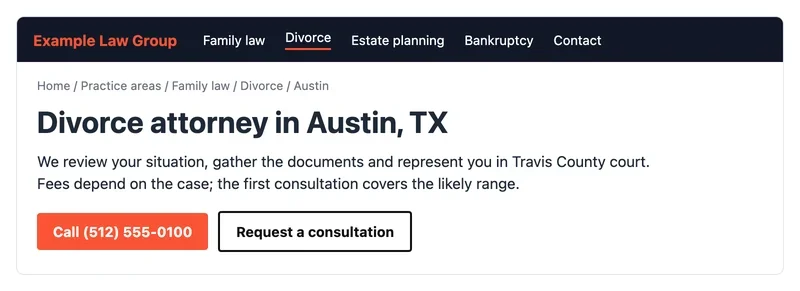
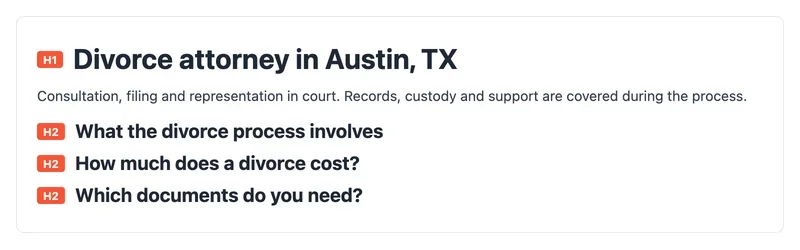
Each sub-service page describes one client situation. The first screen needs a heading with the service and city, a short explanation of what you do and in what order, a cost range or at least what drives the price, a call button and a short form. Breadcrumbs and the menu show people and crawlers where the page sits. Here is how that first screen can look.
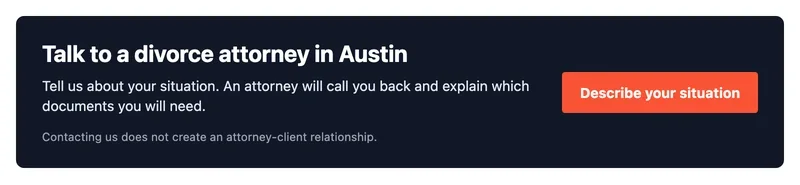
At the bottom of the page, add a block that names the client's problem and gives one clear next step. Word the call to action as a next step, not a promise of an outcome: "Tell us about your situation and an attorney will call you back and explain which documents you will need." A short line saying that contacting the firm does not create an attorney-client relationship is common practice; ask your own counsel for the wording your state expects.
If you have several offices, reflect that in the structure and in the contacts: a page and a Google Business Profile for each real office, with its own address and phone number. Separate city subdomains only make sense when their content really differs from the main site.
Who wrote the answer: attorney bios and E-E-A-T
A client wants to know that a practicing lawyer wrote the answer, not a content mill. Search systems look for the same thing, and the signals are the ones visible on and around the page. Put an author block under every article and on every practice area page:
- the name and photo of the attorney who wrote or reviewed the text;
- bar admissions: the state or states where the attorney is licensed, the bar number and a link to the state bar's lookup page, so a reader can check it;
- education, focus areas and years in that practice area, not only years since graduation;
- the date the text was last reviewed and the law it relies on;
- links to statutes, court rules and the attorney's publications.
Be careful with wording about expertise. New York's Rule 7.1(c) bars stating or implying certified-specialist status unless an approved or ABA-accredited organization certified the lawyer and the communication names it; the comment still allows saying you concentrate in a field based on experience, training or education, subject to the false-or-misleading standard (see the New York Rules of Professional Conduct as amended). Other states differ, so confirm yours before writing "board certified" or "specialist."
A separate page for each attorney collects searches by name and ties together everything that person has written. Add the bar lookup link, publications and talks: that is how both people and search systems confirm that the author exists and actually works in this area. Do not invent profiles. Google's guidance warns that fabricated creator profiles are a sign of untrustworthy content.
If a marketer drafts the text, the attorney reviews it and signs as reviewer with the same review date. An anonymous firm blog gives neither clients nor Google anything to hold on to. Structured data helps connect the pieces: Schema.org has a LegalService type (with Attorney as a subtype) for the firm, Person for authors, and Google documents Article markup with an author for posts.
Answering legal questions without crossing a line
Informational queries are plentiful in law: more people ask how to handle a deadline than search for a lawyer by name. A good answer article reaches a person while they are still working out their situation and leads them to the sub-service page. Keep to general explanations of how a rule works; individualized advice to strangers does not belong on a public page. Never put client facts in an example: the Florida Bar's comment to rule 4-7.13 says advertising past results requires the affected client's informed consent, even if the facts are public record.
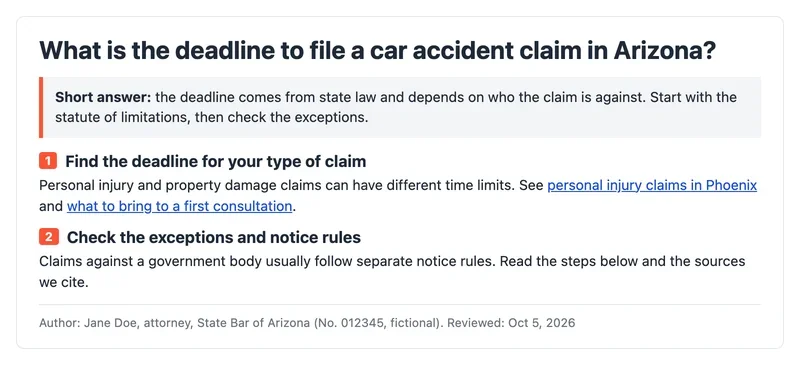
- The heading repeats the person's own question: "What is the deadline to file a car accident claim in Arizona?"
- The first paragraph gives a short, direct answer, then conditions and exceptions.
- Citations point to the statutes and court rules themselves, not to other blogs.
- Steps and a document list appear where they apply.
- The author block and the review date follow.
- The end of the page links to the sub-service page and offers a conversation about the reader's own situation.
Legal articles age with the law: keep a register with review dates and recheck it when your practice area changes. An outdated page on filing deadlines damages trust more than no page.
Advertising rules: what the bar allows on your website
The ABA rewrote its advertising rules in 2018 around one plain standard, and New York is a recent adopter. New York's Appellate Divisions adopted the model language in amendments effective June 1, 2026, and the State Bar's summary of the amendments describes the result: Rule 7.1 now covers every communication about a lawyer or the lawyer's services, not just advertising. A communication is false or misleading if it contains a material misrepresentation of fact or law, or leaves out a fact needed to keep the whole from misleading. Truthful statements can mislead too. In New York's numbering, the rest of the chapter handles paying others for referrals (7.2), solicitation (7.3) and firm names and websites (7.5); specialization moved into 7.1(c).
The comments to New York's Rule 7.1 spell out what that means on a website. A firm's name, domain name, website and social pages are all communications that must not mislead. A truthful report of a past result can mislead if it suggests the same result for other clients without reference to the facts of each case, and an unsubstantiated comparison can mislead if stated with enough specificity that a reader assumes it can be proven. Rule 7.1(d) also requires every communication to name at least one responsible lawyer or firm and give contact information.
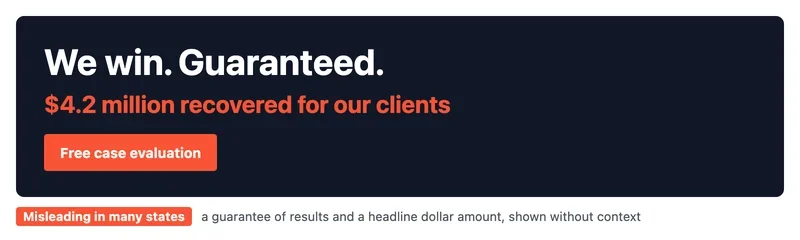
Rule 7.5 covers names: comment [11] says a firm may not use a trade name such as "Win Your Case" or the domain winyourcase.com, because they imply favorable results regardless of the facts. Check your domain and Business Profile name against that logic.
States differ in detail, and the difference matters when you write copy. Three examples:
| Topic | New York (Rules of Professional Conduct) | California (Bus. & Prof. Code, art. 9.5) | Florida (Rules Regulating the Bar, 4-7) |
|---|---|---|---|
| Guarantees and predictions | Misleading statements barred by Rule 7.1(a); comment [3] on unjustified expectations | No guarantee or warranty of success; no "immediate cash or quick settlements" (6157.2(a)(1)-(2)) | Statements a client can read as a prediction or guaranty of success or specific results (4-7.13(b)(1)) |
| Past results | May mislead without context; an appropriate disclaimer can help (comment [3]) | In electronic media (defined to include computer networks), results shown out of context and references to money recovered are presumed misleading (6158.1) | Only if objectively verifiable; atypical results can mislead; client's informed consent needed (4-7.13 comment) |
| Testimonials | No separate rule since the 2026 amendments; the old required disclaimer was removed, but the general standard applies | No ban in 6157.2; impersonating a client or dramatizing events needs disclosure (6157.2(a)(3)(B)) | Six conditions, including real experience, no drafting by the lawyer, nothing of value in exchange, and a "may not obtain the same results" disclaimer (4-7.13(b)(9)) |
| "Best," "top" and similar claims | Unsubstantiated comparisons may mislead (comment [3]) | No misleading statements about skills, experience or record (6157.2(a)(5)) | Characterizations must be objectively verifiable; "best" and "second to none" generally fail (4-7.13 comment) |
| Scope | Every communication about a lawyer's services, including website and social pages (7.1 comments [1] and [5]) | Any written, recorded or electronic communication meant to encourage people to hire the lawyer (6157(b)) | Websites and social media like any other medium (4-7.11) |
| Who is responsible | Name and contact details of a lawyer or firm (7.1(d)) | Name of a California-licensed lawyer or the firm, plus the city or county of an office (6157.2(b)) | Not covered by the sources we read; check the rules |
California is the strictest on money in the list. The statute is long, and its text is worth reading once in full; this is the list of what an advertisement may not contain or refer to:
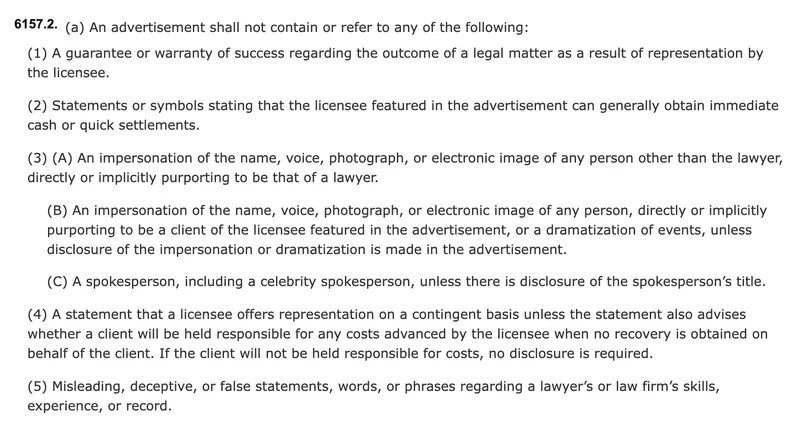
The same section lets a misled consumer sue after a State Bar complaint process: statutory damages of $5,000 to $100,000 per unique advertisement, or three times actual damages if larger (section 6157.2(c)). Florida's rules apply to websites and social media like any other medium (rule 4-7.11). If you are licensed in several states, more than one set of rules can apply.
One practical rule from Florida's comment fits any state. Words describing a goal are generally fine, while words promising a result are not. The comment contrasts a promise to get a client acquitted with a statement of intent:
"I will pursue an acquittal of your pending charges"
Florida Bar, comment to rule 4-7.13, offered as acceptable wording
Use words like "pursue," "seek" and "try," and keep "will win," "guaranteed" and "we get results" out of headlines, titles, snippets and ad copy.
Reviews and testimonials: what is allowed and how to ask
Most SEO checklists for lawyers suggest a review block, case results with dollar amounts and a win count on the first screen. In the United States the answer is "it depends on your state and on how you do it," and two layers of rules apply: the bar rules above and general advertising law.
The general layer is the FTC's Consumer Reviews and Testimonials Rule, in effect since October 21, 2024. The FTC's staff answers say several things a law firm should know:
- A business that puts testimonials on its own website is disseminating them, not merely hosting reviews, and it could be liable if they are fake or false.
- A business may not buy positive or negative reviews, and may not imply that an incentive depends on a particular sentiment; incentives that are not tied to sentiment are not banned by the rule, but undisclosed incentives can still break the FTC Act.
- Asking for reviews only from customers you expect to be happy is not banned by the rule itself, but the FTC says it could violate the FTC Act.
- Reviews you feature in your own marketing become testimonials, and the review-hosting exemption does not cover them.
Platforms add their own rules. Google's guidance on reviews allows you to ask customers to leave a review through a link or QR code, and it bans offering free or discounted goods or services in exchange for posting, changing or removing a review. For a law firm that also means no "free consultation for a five-star review."
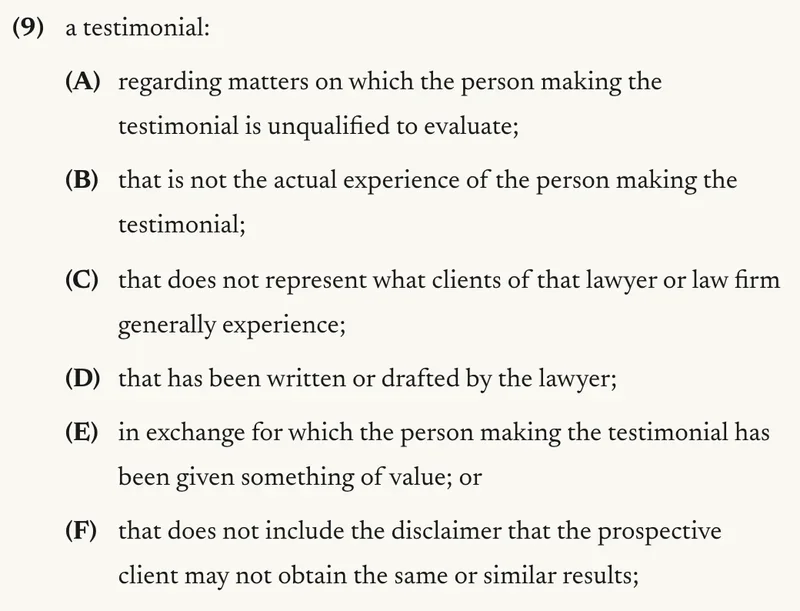
Then the bar layer. Florida's rule 4-7.13(b)(9) bars a testimonial on matters the person cannot evaluate, one that is not the person's real experience, one that does not reflect what the firm's clients generally experience, one drafted by the lawyer, one given in exchange for something of value, and one without a disclaimer that the prospective client may not obtain the same results. Here is that list in the rule text:
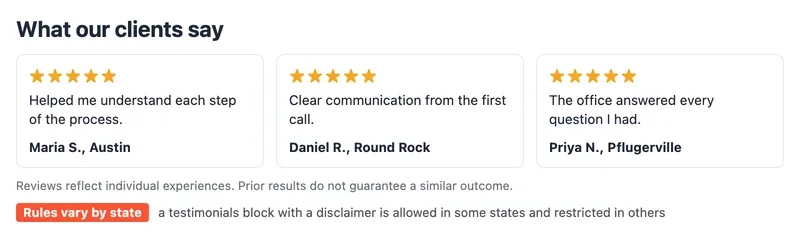
A review block with first names, a disclaimer and a note about what a reader can expect is how many firms build the section in states that allow it. Check your state first, because a state may restrict or forbid what another allows.
Replying to reviews has its own trap: confidentiality. As the ABA Journal reports on ABA Formal Opinion 496, a negative online review does not by itself let a lawyer reveal client information, and the best response is often none. If you reply, keep it generic: invite the person to call, or say that professional obligations limit what you can say. Even a general denial can confirm the reviewer was a client.
Title, description and headings for practice pages
Write a title and description for every page in the matrix. A workable title formula is the service, the city and one detail that sets you apart, for example "Divorce Attorney in Austin, TX: Custody, Property, Support." Google says in its guidance on title links that a title is truncated in results as needed to fit the device width, so put the service and the city first. The description should say in a sentence or two what the work includes and how to reach you.
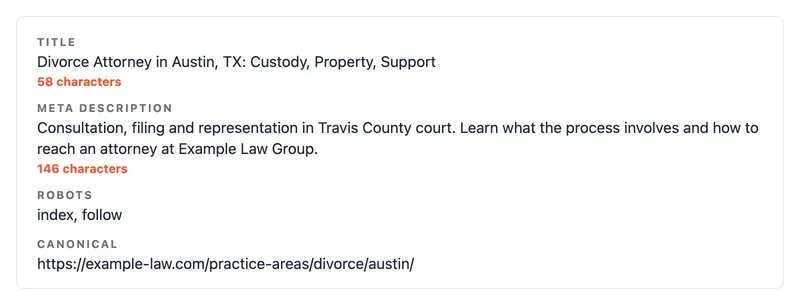
The same ethics rules apply to the snippet. "We'll win your case" and "get every dollar back" in a title are what the guarantee rules above target. Specifics work better: "consultation, filing, representation in court."
Use one H1 with the main message, which on a practice page is the service and the city. H2 subheadings open the next blocks and answer the client's questions: what the work includes, what it costs, which documents are needed, how the process runs.
Internal links lead from articles to sub-services and from sub-services to the practice area, and the link text names the service in words ("dividing a house with a mortgage"), not "learn more" or "click here." Google's SEO starter guide makes the same point about descriptive link text.
Links, directories and mentions
For a law firm, outside links act as proof of reputation. Mentions count most where other lawyers and clients read: your state and local bar association, law school and CLE pages, local business media, and well-known legal directories such as Avvo, Justia and FindLaw. You can earn them in three ways:
- list the firm in directories and professional associations with the same name, address and phone number everywhere;
- ask: partners, corporate clients and organizers of events where you spoke often link to a speaker profile;
- earn them: a column explaining a new law, a comment to a reporter, a summary of local court practice.
The bar rules draw a line here. The comment to New York's Rule 7.2 says a lawyer may pay for online directory listings, search engine optimization, internet ads and lead generators, as long as the lead generator does not recommend the lawyer and the comment's other conditions are met. Paying a lead generator that states or implies it is recommending you is the problem, so read a vendor's marketing copy before you sign.
Mass-bought links from sites with no connection to law save time only at the start. Google's spam policies list buying or selling links for ranking purposes and links with optimized anchor text in guest posts and advertorials as link spam. A firm's link profile grows slowly, and that is normal: variety of sources and a steady pace matter more than a jump in a couple of weeks.
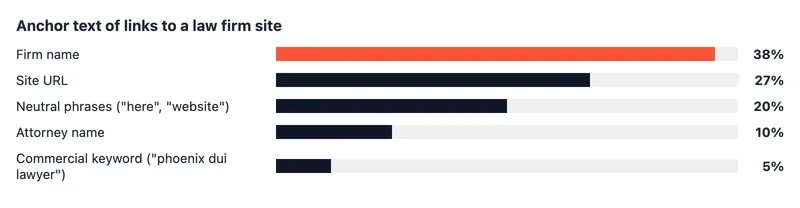
Competitor service pages seldom earn links; guides and reference pages do, so publish at least one piece colleagues and reporters will want to cite. Anchor text should look natural: the firm name, an attorney's name, the site address. If most anchors match a commercial query, the profile looks manufactured.
Local search: Google Business Profile, the map pack and Local Services Ads
Most legal searches are local. Google decides local results mainly on relevance, distance and prominence, and says there is no way to request or pay for a better local ranking (tips to improve your local ranking). Prominence draws on reviews and on links to your website, so everything above feeds into it.
Your Business Profile has its own rules for law firms. Google's guidelines for representing your business say:
- an office rented only as a mailing address (a virtual office) is not eligible for a profile;
- a co-working space counts only if it has clear signage, receives customers during business hours and is staffed by your own staff during those hours;
- the business name should be the real-world name used on your storefront, website and stationery, without marketing taglines, phone numbers or URLs;
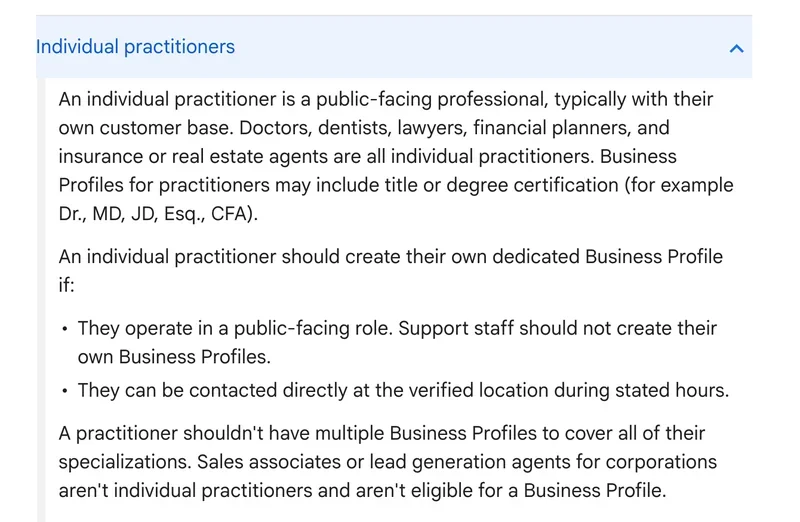
- lawyers count as individual practitioners: a practitioner may get a dedicated profile if they work in a public-facing role and can be contacted at the verified location, but should not create several profiles to cover different specializations;
- when several practitioners work at one location, the firm has its own profile and each practitioner's profile carries only that person's name, while a sole practitioner at a branded office should use a single profile in the format "[brand]: [practitioner name]."
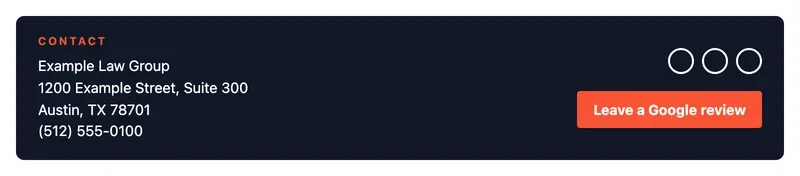
Write the address in full as text, with the suite number, and keep the name, address and phone number identical on your site, your Business Profile and in directories. A footer contact block with a review button helps.
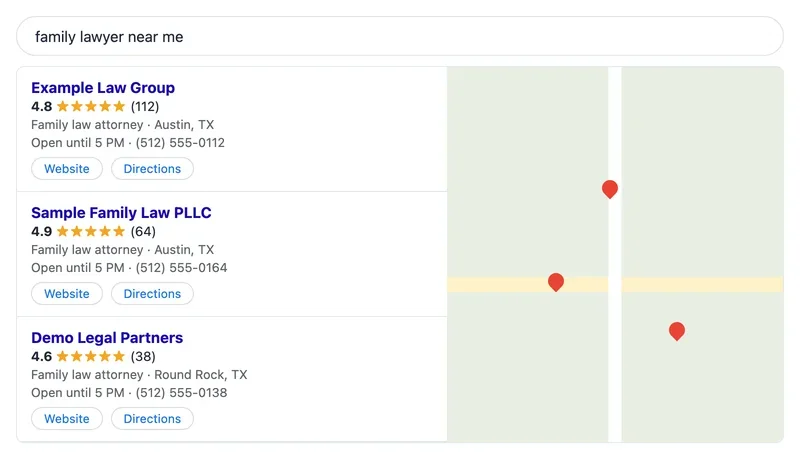
For searches like "family lawyer near me," Google shows a map and a few firms with ratings, and that block is often more visible than any organic position. The profile collects its own traffic by name and service, so fill it in as carefully as a site page.
This is the part of the guidelines that covers lawyers:
Local Services Ads for lawyers
Local Services Ads (LSA) appear prominently in Google Search results and charge you per lead, not per click. Google's overview lists many legal categories, including bankruptcy, business, criminal, DUI, estate, family, immigration, personal injury, real estate and traffic lawyer services, though availability depends on your area, so run Google's eligibility check first. The customer taps to call or message you, and you pay for valid leads.
Money works like this, per Google's page on how leads work: you set an average weekly budget and a bidding mode, you can spend more than the weekly figure in a given week but never more than the monthly maximum, lead prices vary with location, job type, lead type and bidding mode, and leads judged invalid or low quality are not charged. Because prices vary so much by market, start with a small test, for example $250 to $500 a week for the first month (illustrative, not a benchmark), and judge it by cost per signed client, not cost per lead.
The trust badge has changed. Google now issues a single Google Verified badge to all advertisers in place of the earlier badges, and is discontinuing the money-back guarantee tied to the Google Guarantee badge (reimbursement requests had to be submitted before December 7, 2025). New advertisers earn the badge by completing Google's screening and verification process, which can include license, insurance and background checks depending on the category. Your Business Profile reviews matter here too, because Google's onboarding for professional categories checks reviews against category requirements.
Also note the platform shift. Google announced that Local Services Ads campaigns are being migrated to Performance Max campaigns with pay-per-lead goals inside Google Ads, in phases: home services first from August 2026, broader groups in late 2026 and remaining categories in 2027. Verified status carries over and placement stays on Search and Maps, but old Local Services reports will not move, so download them first. Whatever the dashboard, an LSA profile and its ad copy are communications about your services and must meet the same truthfulness standard as your site.
The technical basics: indexing, speed, mobile
Run the technical check first: while pages are not indexed or take five seconds to open, content does nothing. Use Google Search Console to confirm that Google can find and crawl your site and to fix indexing problems. HTTPS is a must, since intake forms carry personal details. Our index checker and guide to getting a site indexed cover the common causes.
Speed and mobile layout matter because many people search from a phone at the moment of the problem. Google's Core Web Vitals guidance recommends that the largest content element loads within 2.5 seconds, interaction responds in under 200 milliseconds and layout shift stays under 0.1; Search Console reports how your pages perform. Check by hand that the call button is tappable, the phone number is a link and the form does not ask for ten fields.
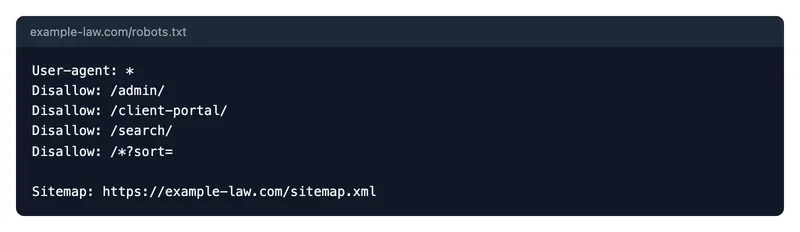
Keep service areas of the site, the client portal, internal search and parameter pages out of crawling with robots.txt. Remember Google's warning that robots.txt is not a way to hide pages from results.
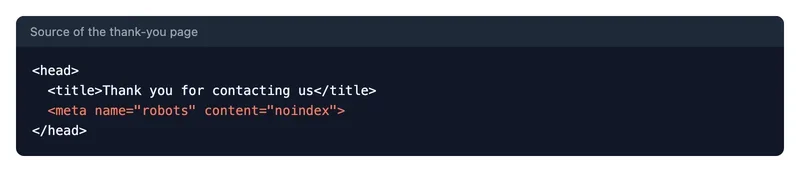
Pages people may open but that should stay out of results, such as the thank-you page after an inquiry, get a noindex tag. Google's noindex documentation adds that the page must not also be blocked in robots.txt, or Google will never see the tag.
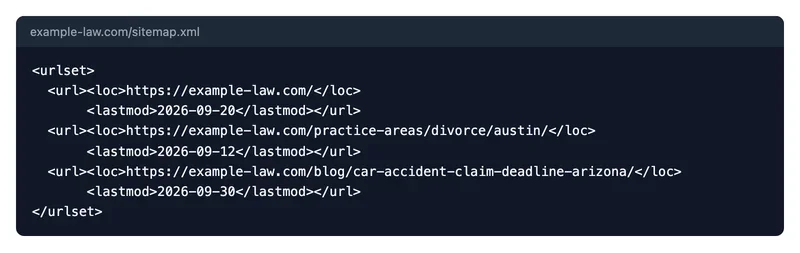
An XML sitemap lists practice, sub-service and article pages with their last-modified dates. Submit it in Search Console; Google's sitemap overview explains the format and what it tells the crawler.
Law firm sites have their own technical traps that generic checklists skip:
- do not publish city and sub-service pages in bulk without their own text: fill them in or keep them unpublished;
- PDF templates duplicate articles: name the files clearly and link them to a page explaining how to complete the document;
- update articles on repealed or amended rules, or 301-redirect them to the current article;
- test the intake form after every site update, and tell visitors not to send confidential details before an engagement.
Technical checks should be recurring, not a launch task: RedHunt Checker monitors site health and shows how changes affected traffic.
How do you know the SEO is working?
Track rankings by group from the matrix: practice area and city, commercial and informational queries separately, and each office city separately. That shows which cell grows, which one stalls and where to add content or links. RedHunt rank tracking checks positions in Google.
Positions without inquiries mean little, so keep a minimum set of reports next to them:
- goals or key events in Google Analytics for form submissions, taps on the phone number and messaging buttons;
- Search Console data on which queries show your pages and how often they are clicked;
- calls from the site counted separately from forms, since many legal clients prefer to call;
- inquiries split by practice area and city, so you see which cell of the matrix brings matters.
Once a month, search for your attorneys' names and the firm name. This is what someone sees after a referral, checking you before calling: your site, your Business Profile, your bar profile and your publications should all be near the top and say the same thing.
Timing depends on competition in your city and the state of the site. Google's SEO starter guide says some changes take effect in a few hours and others could take several months, and advises waiting a few weeks before judging a change. In our experience a competitive city needs months, and we do not promise a date. Narrow queries with a city and a specific situation usually grow sooner, so build the first report for the firm's partners around them: which pages reached the top 10 and how many inquiries they produced.
Once a quarter, check the matrix against the facts. Cells that have not moved into the first three pages after six months are rewritten or merged with neighbors, and practice areas that produce inquiries are expanded with new sub-services and articles.
Frequently asked questions
How do you promote a law firm website?
Start with keywords by practice area and city, then build sub-service pages with a clear process, a cost range and an inquiry form. Add attorney bios, answer articles, a verified Google Business Profile and reviews collected within your state's rules, then fix the technical base and track each group of queries.
Can a lawyer do their own SEO?
Yes, if you have time to write and review the text: you know your clients' questions better than any agency. A technical audit, structured data and link building are easier to hand to a specialist, but a practicing attorney should still review every legal claim and advertising statement before publication.
Where should a law firm start with SEO?
Choose two or three practice areas and cities, check demand, and get the technical minimum right: a fast, mobile-friendly, indexed site and a verified Google Business Profile. Then build the sub-service pages and the first answer articles.
Do lawyers need to follow special rules for online marketing?
Yes. A website, a Google Business Profile and a Local Services Ads profile are communications about a lawyer's services, and your state bar's advertising rules apply to all of them, along with general advertising law such as the FTC's rule on reviews and testimonials. Rules differ by state, so compare your state's current text before you publish guarantees, results, testimonials or specialist claims.
Дата публикации:
Задать вопрос
Вопросы и ответы
Пока нет опубликованных вопросов. Задайте первый — после модерации он появится здесь.
Вам также может понравиться
Все статьи
Local business
Local SEO: How to Get Your Local Business Into Google Maps and the Local Pack
US local SEO: Google Business Profile, local pack, Apple Maps, Bing, Yelp, NAP and citations, location pages, reviews rules and a three-month plan.

Aesthetic medicine
Plastic surgery marketing: how to promote a practice within FTC, HIPAA and state board rules
Plastic surgery marketing in the US: FTC rules, HIPAA photo authorization, board certification claims, Google and Meta ad policies, reviews and financing.
Technical SEO
Website indexing: how it works, how to check it and how to speed it up
How Google indexes a site, how to check pages in Search Console, and how to speed it up with sitemaps, URL Inspection and IndexNow.

Fintech
SEO for Fintech Companies: Win Search Traffic and Customer Trust in the US
US fintech SEO: YMYL trust signals, not-a-bank and FDIC wording, product pages, app and web, PCI DSS, reviews, GA4 metrics and CFPB, FINRA and SEC ad rules.